

Simchas Torah
- noun
- /ˈsɪm.khɑs ˈtɔː.rə/
- On Simchas Torah, the congregation completes the yearly cycle of Torah readings and immediately begins again from Genesis.
Examples
-
Jewish communities around the world celebrate Simchas Torah with joyous dancing and singing.
-
Children often carry flags and dance during the festivities of Simchas Torah.
-
On Simchas Torah, the congregation completes the yearly cycle of Torah readings and immediately begins again from Genesis.
-
We celebrate Simchas Torah with joy and dancing.
-
Is Simchas Torah your favorite holiday?
-
Jewish communities around the world celebrate Simchas Torah with joyous dancing and singing.
-
Children often carry flags and dance during the festivities of Simchas Torah.
Synonyms
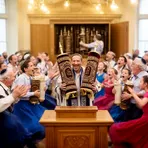


 1
8.4
1
8.4
A Jewish festival to celebrate finishing the yearly Torah readings and starting them again with dancing and singing

A Jewish festival celebrating the end of the yearly Torah readings

A Jewish holiday at the end of Sukkot when people celebrate finishing the yearly Torah readings

A Jewish festival when people finish and immediately begin the yearly Torah readings, often with singing and dancing
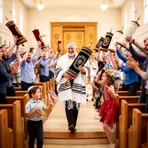
A Jewish holiday when people joyfully celebrate finishing the yearly reading of the Torah
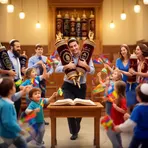
A Jewish holiday celebrating the end of the yearly reading of the Torah
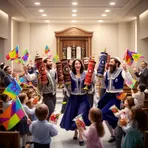
A Jewish festival celebrating finishing the yearly reading of the Torah
Surface Forms
Morphology
Simchas + Torah
If a learner knows 'Simchas' as rejoicing/joy and 'Torah' as the Jewish scripture, the phrase transparently composes to 'rejoicing of the Torah' and signals a joyful Torah-related celebration. However, 'Simchas' is a non-English (Hebrew/Yiddish) form and the precise cultural meaning ( timing at the end of Sukkot and completion of the reading cycle) is not fully predictable from the constituents alone, so full understanding requires cultural knowledge.
Etymology
Simchas Torah comes from the Hebrew words Simchas and Torah, meaning 'joy' and 'the Torah'. On this holiday people finish the year's readings of the Torah and dance with the scrolls, so the name points to a joyful celebration that marks the end of the yearly readings and the fact that they start them again.