
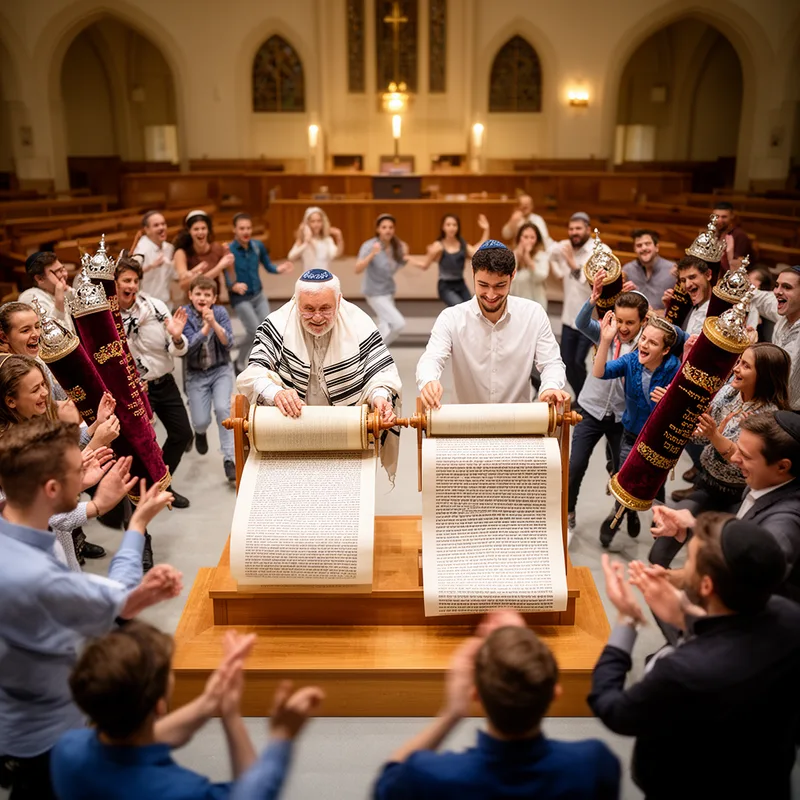
Shimchath Torah
- noun
- /ʃɪmˈkɑːθ ˈtɔːrə/
- During Shimchath Torah, it is customary to read the last passage of the Torah and immediately begin again from Genesis.
Examples
-
Many families celebrate Shimchath Torah by dancing with the Torah scrolls at the synagogue.
-
The festive atmosphere of Shimchath Torah brings the entire congregation together in joyful celebration.
-
We celebrate Shimchath Torah with joy and singing.
-
On Shimchath Torah, the community comes together.
-
During Shimchath Torah, it is customary to read the last passage of the Torah and immediately begin again from Genesis.
-
Many families celebrate Shimchath Torah by dancing with the Torah scrolls at the synagogue.
-
The festive atmosphere of Shimchath Torah brings the entire congregation together in joyful celebration.
Synonyms


 1
8.4
1
8.4
A Jewish festival to celebrate finishing the yearly Torah readings and starting them again with dancing and singing

A Jewish festival celebrating the end of the yearly Torah readings
A Jewish festival celebrating finishing the yearly reading of the Torah
A Jewish holiday celebrating the end of the yearly reading of the Torah
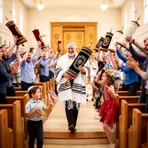
A Jewish holiday when people joyfully celebrate finishing the yearly reading of the Torah

A Jewish holiday at the end of Sukkot when people celebrate finishing the yearly Torah readings
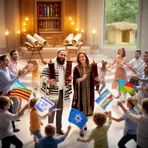
A Jewish holy day at the end of Sukkot when people celebrate finishing the yearly Torah readings
Surface Forms
Morphology
Shimchath + Torah
The phrase is a transparent compound of a Hebrew word meaning 'rejoicing/celebration' (Shimchath) plus 'Torah' (the Torah), so its meaning as a festival celebrating the Torah and the completion of readings is directly derivable from the constituents. Although it is a transliterated proper name and culturally specific, its compositional structure is clear and similar 'rejoicing of X' constructions exist cross-linguistically, so a learner who knows both parts would understand it.
Etymology
Shimchath Torah comes from the words Shimchath, meaning 'joy' or 'rejoicing', and Torah, the Jewish holy book. On this day people celebrate finishing the yearly reading of the Torah and immediately begin it again, often dancing with the scrolls, so the name explains the festival of 'joy with the Torah'.