

Rejoicing in the Law
- noun
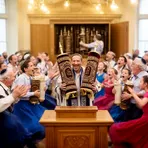
- During Rejoicing in the Law, the Torah scrolls are carried around the synagogue in joyful procession.
Examples
-
The community gathered to celebrate Rejoicing in the Law with dancing and singing.
-
As part of Rejoicing in the Law, children often receive sweets and join in the festivities.
-
During Rejoicing in the Law, families gather to celebrate together.
-
Many people attend Rejoicing in the Law services at their synagogues.
-
As part of Rejoicing in the Law, children often receive sweets and join in the festivities.
-
During Rejoicing in the Law, the Torah scrolls are carried around the synagogue in joyful procession.
-
The community gathered to celebrate Rejoicing in the Law with dancing and singing.
Synonyms


 1
8.4
1
8.4
A Jewish festival to celebrate finishing the yearly Torah readings and starting them again with dancing and singing

A Jewish festival celebrating the end of the yearly Torah readings

A Jewish festival when people finish and immediately begin the yearly Torah readings, often with singing and dancing

A Jewish holy day at the end of Sukkot when people celebrate finishing the yearly Torah readings

A Jewish holiday at the end of Sukkot when people celebrate finishing the yearly Torah readings
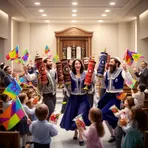
A Jewish festival celebrating finishing the yearly reading of the Torah
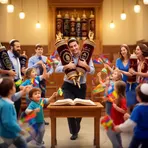
A Jewish holiday celebrating the end of the yearly reading of the Torah
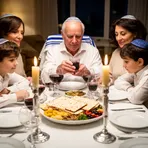
A religious holiday in the Jewish tradition, like Passover or Yom Kippur
Surface Forms
Morphology
The phrase is compositionally interpretable: a learner who knows 'rejoicing', 'in' and 'law' would likely infer a celebration related to 'the law' (i.e. happiness about a legal or religious text). However, the expression is a proper name for a specific Jewish holy day (Simchat Torah) marking the completion of the annual Torah readings, and that cultural and calendrical specificity (and the reading of 'the Law' as 'the Torah') is not recoverable from the words alone, so it is not fully transparent.
Etymology
Rejoicing in the Law is the English name for the Jewish holiday 'Simchat Torah', when people carry the 'Torah' scrolls, sing and dance in the synagogue after the year's readings are finished. That's why the phrase means a joyful celebration of finishing and starting the 'Torah' readings.