
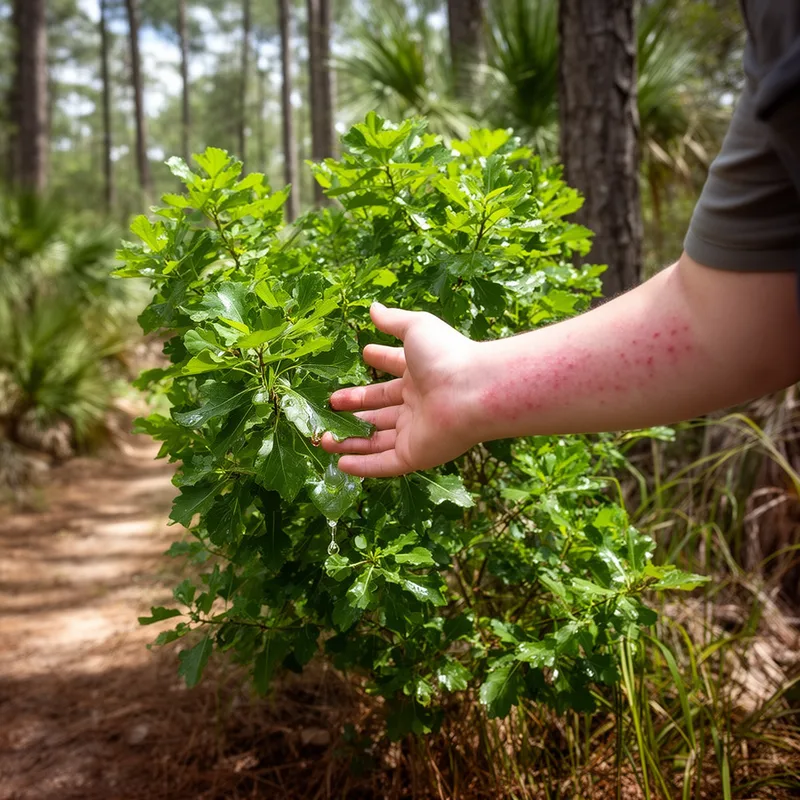
Rhus quercifolia
- noun
- Specialized
- Hikers should avoid touching Rhus quercifolia to prevent a painful skin rash.
Examples
-
Many people are allergic to Rhus quercifolia, as it can cause severe skin reactions.
-
Many people are allergic to Rhus quercifolia.
-
Local folklore often warns children about the dangers of Rhus quercifolia in wooded areas.
-
The botanist collected samples of Rhus quercifolia for research on poisonous plants.
-
Be careful around Rhus quercifolia.
-
Hikers should avoid touching Rhus quercifolia to prevent a painful skin rash.
-
Local folklore often warns children about the dangers of Rhus quercifolia in wooded areas.
Synonyms

 3
6.5
3
6.5

A climbing or spreading plant with oak-like leaves that makes oil causing skin rash

A shrub that causes an itchy skin rash when you touch it, called poison oak

A poisonous bush that causes a skin rash when you touch it

A plant that causes a skin rash when you touch it
Surface Forms
Morphology
Rhus + quercifolia
This is a Latin binomial (genus + specific epithet). While 'Rhus' signals a sumac (so a plant), the epithet 'quercifolia' is not a common English word (missing from the dictionary) and the species-specific information that it is poisonous and causes a rash cannot be inferred from the parts. A B1 learner who knows the listed constituent words would therefore not reliably derive the full meaning.
Etymology
Rhus quercifolia comes from old Latin words: Rhus meaning 'sumac' and quercifolia meaning 'oak-leaved' because its leaves look like small oak leaves. That picture — a sumac with oak-like leaves — helps you remember this poisonous shrub that can give a skin rash if you touch it.