
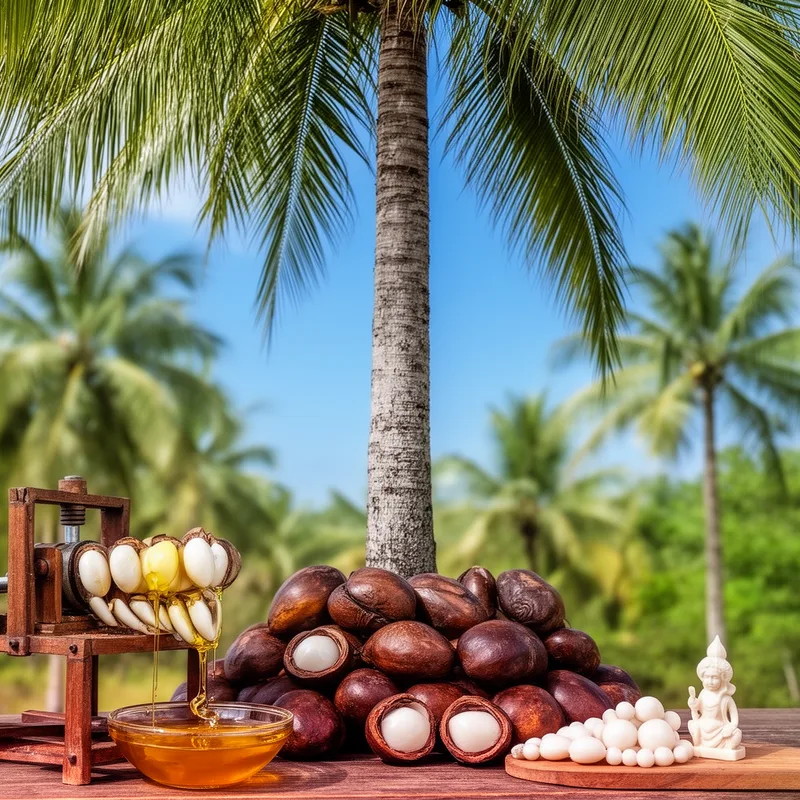
Orbignya phalerata
- noun
- Specialized
- The Orbignya phalerata is cultivated for its nuts, which are pressed to extract oil.
Examples
-
Much of the vegetable ivory used in crafts comes from the Orbignya phalerata.
-
The Orbignya phalerata is prized for its hard-shelled nuts, which are harvested to extract valuable oil.
-
In northern Brazil, products derived from Orbignya phalerata support many local communities.
-
The Orbignya phalerata is known for its tall stature.
-
Many artisans use Orbignya phalerata nuts for crafting.
-
In northern Brazil, products derived from Orbignya phalerata provide essential income for many local communities.
-
Much of the vegetable ivory used in crafting beautiful objects comes from the Orbignya phalerata palm.
Synonyms

A tall palm tree from northern Brazil that has hard nuts used to make oil and a material like ivory

A tall palm tree from northern Brazil that has hard nuts with oil and a white core used like ivory
A tall palm from northern Brazil that makes hard nuts used for oil and carved like ivory

A tall palm from northern Brazil with hard nuts that give oil and a material like ivory for carving

A tall palm from northern Brazil with hard nuts that give oil and a material like ivory
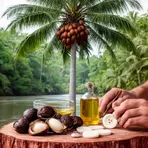
A tropical palm tree whose large nuts make oil and vegetable ivory used for carving

A tall tropical palm tree with large nuts that give oil and a hard material like ivory
Surface Forms
Morphology
Orbignya + phalerata
This is a Latin binomial (scientific species name) functioning as a proper noun rather than a compositional English phrase; the overall meaning (a specific palm species) is not derivable from the parts. One constituent is a specialized genus name and the other is not a standard English word, so a B1 learner who knows ordinary English vocabulary would not be able to infer the MWE's meaning without botanical knowledge.
Etymology
Orbignya phalerata is a tall palm from northern Brazil with feather-like leaves and very hard, round nuts. The nuts can be squeezed to make 'oil' and can be carved like real ivory, called 'vegetable ivory', so the name helps you picture a palm used for both 'oil' and 'vegetable ivory'.

