

Orbignya martiana
- noun
- Specialized
- The nuts of the Orbignya martiana are harvested to extract both oil and vegetable ivory.
Examples
-
The durable seeds of Orbignya martiana are often used for carving decorative items.
-
Botanists studied the Orbignya martiana and its contribution to local ecosystems in northern Brazil.
-
The Orbignya martiana is a remarkable palm tree.
-
Many Orbignya martianas thrive in the Amazon rainforest.
-
The nuts of the Orbignya martiana are harvested to extract both oil and vegetable ivory.
-
Botanists studied the Orbignya martiana and its contribution to local ecosystems in northern Brazil.
-
The durable seeds of Orbignya martiana are often used for carving decorative items.
Synonyms

A tall palm tree from northern Brazil that has hard nuts used to make oil and a material like ivory
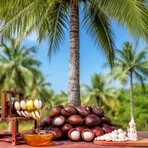
A tall palm tree from northern Brazil whose hard nuts produce oil and a white, ivory-like material

A tall palm from northern Brazil with hard nuts that give oil and a material like ivory for carving
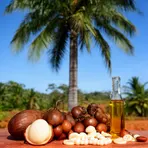
A tall palm from northern Brazil that makes hard nuts used for oil and carved like ivory

A tall palm tree from northern Brazil that has hard nuts with oil and a white core used like ivory
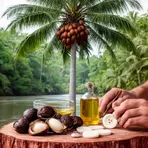
A tropical palm tree whose large nuts make oil and vegetable ivory used for carving
Surface Forms
Morphology
Orbignya + martiana
This is a Latin binomial (scientific) name rather than a compositional English phrase, so its meaning (a particular palm species) cannot be derived by combining the literal senses of the parts. One element ('martiana') is not a productive English lexical item and the genus name functions as a proper noun; understanding that this refers to a palm requires botanical/taxonomic knowledge rather than simple word-composition, making it unpredictable for a B1 learner.
Etymology
Orbignya martiana is named after two people: the genus Orbignya is named for the French naturalist d'Orbigny and the species martiana is named for the botanist Martius. Picture a tall feather palm with their names on its trunk, and that image helps you remember it is the northern Brazilian palm whose hard nuts give oil and 'vegetable ivory'.

