

Orbignya spesiosa
- noun
- Specialized
- Artisans carve the hard nuts of Orbignya spesiosa to produce objects resembling ivory.
Examples
-
Many cosmetic products contain oil extracted from the seeds of Orbignya spesiosa.
-
The Orbignya spesiosa tree can grow up to 20 meters tall.
-
The Orbignya spesiosa is an important source of oil in rural areas of Brazil.
-
Farmers in Brazil cultivate Orbignya spesiosa for its nuts.
-
Artisans carve the hard nuts of Orbignya spesiosa to produce objects resembling ivory.
-
Many cosmetic products contain oil extracted from the seeds of Orbignya spesiosa.
-
Farmers in Brazil cultivate Orbignya spesiosa for its valuable nuts.
Synonyms

A tall palm tree from northern Brazil that has hard nuts used to make oil and a material like ivory

A tall palm tree from northern Brazil that has hard nuts with oil and a white core used like ivory
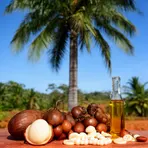
A tall palm from northern Brazil that makes hard nuts used for oil and carved like ivory
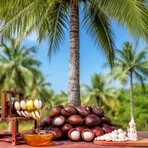
A tall palm tree from northern Brazil whose hard nuts produce oil and a white, ivory-like material

A tall palm from northern Brazil with hard nuts that give oil and a material like ivory
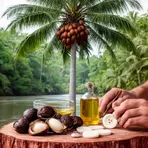
A tropical palm tree whose large nuts make oil and vegetable ivory used for carving
Surface Forms
Morphology
Orbignya + spesiosa
This is a scientific binomial: knowing 'Orbignya' (a babassu/palm genus) gives the learner a general idea that it is a palm, so part of the meaning (that it is a tree/palm) is recoverable. However, the specific sense conveyed by the species epithet ('spesiosa' is not a common English word here) and the detailed properties (hard-shelled nuts, oil, height) are not derivable from the parts, so the expression is only partially transparent.
Etymology
Orbignya spesiosa is a tall palm with feathery leaves and very hard, round nuts. People carve the nuts like small pieces of ivory and press the seeds to make oil, so the name brings to mind a tree known for 'vegetable ivory' and 'oil'.

