

coco de macao
- noun
- Specialized
- The coco de macao is valued for its hard nuts, which can be carved like ivory.
Examples
-
Many artisans in Brazil use coco de macao to make jewelry and buttons.
-
The oil extracted from the coco de macao has a variety of commercial applications.
-
The coco de macao tree is native to Brazil.
-
Many artisans use coco de macao for crafting.
-
Many artisans in Brazil use coco de macao to create beautiful jewelry and buttons.
-
The coco de macao is prized for its hard shells that can be carved into intricate designs.
-
The oil extracted from the coco de macao is used in cosmetics and cooking.
Synonyms
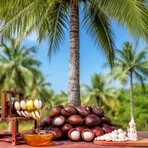
A tall palm tree from northern Brazil whose hard nuts produce oil and a white, ivory-like material

A tall palm from northern Brazil with hard nuts that give oil and a material like ivory for carving

A tall palm from northern Brazil with hard nuts that give oil and a material like ivory

A tall palm tree from northern Brazil that has hard nuts with oil and a white core used like ivory

A tall palm tree from northern Brazil that has hard nuts used to make oil and a material like ivory
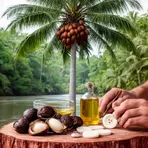
A tropical palm tree whose large nuts make oil and vegetable ivory used for carving

A tall tropical palm tree with large nuts that give oil and a hard material like ivory
Surface Forms
Morphology
coco + de + macao
The element 'coco' clearly signals a palm/coconut-related plant and 'de' functions like 'of' in Romance languages, so a learner would likely infer this is a kind of coconut/palm. However, 'macao' is an uninterpretable proper name/unknown element and the specific botanical properties (oil, vegetable ivory) cannot be derived from the parts, so the overall meaning is only partially predictable.
Etymology
Coco de macao may come from linking coco ('coconut') and macao ('monkey'), because the palm makes hard, coconut-like nuts that monkeys were often seen opening in the trees. That's why the name fits a palm whose hard nuts give oil and a 'vegetable ivory' used for carving.

