

to wear off
 4
4.2
4
4.2

- phrasal verb
- /wɛr ɔf/
- After a minute or two, when the chill had worn off, she found the water friendly, mild, and buoyant.
- the paint has worn off
Loading YouTube…
Watch on YouTubeThe writing on the front is all worn off, but I still have so much left.
- The writing on the front is all worn off, but I still have so much left.
- It just looks a little bit more shiny and a little bit more worn in, but it hasn't worn off.
Examples
-
And how long does it take the paint to wear off?
-
Nearly all the once-shiny black paint had worn off the grip, and the metal beneath was a dull blue-gray, the color of a bad sky.
Fiction book (2002) -
The writing on the front is all worn off, but I still have so much left.
-
But the letters are worn off.
-
Some foundation has worn off here because of the clothing.
-
And I've got to say it has worn off in some areas, but it doesn't look too bad.
-
The Dior lip plumper thing, no, it wore off too fast.
-
Even worse, the silkscreened keycaps have worn off many of the keys.
Blog text (15) -
The finish had worn off the linoleum carpets near the doorways and around the stoves.
Fiction book (1992) -
The excitement from the surprise party began to wear off after everyone had left.
Synonyms
 531
1.2
531
1.2
To slowly become less visible, bright, or loud
 470
3.3
470
3.3
Last without much damage after long use
 146
5.9
146
5.9
To get worse in quality, condition, or value
 83
4.2
83
4.2
Gradually make someone's trust, belief, or support weaker over time
 69
3.0
69
3.0
To become weaker and then disappear over time
 49
2.6
49
2.6
Become less in number, amount, or quality
 27
4.1
27
4.1
Slowly make a person or thing weaker by repeated pressure
 26
2.3
26
2.3
To get damaged or stop working after long use
 19
4.3
19
4.3
To become less in amount or quality
 17
4.1
17
4.1
Slowly damages metal, rock and someone's confidence by chemicals or steady pressure
 2
3.8
2
3.8
To slowly remove material by rubbing or long use
 1
5.6
1
5.6
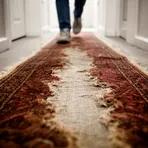
Become thin or damaged from use, like a carpet
Antonyms


How Worn

Surface Forms
Morphology
wear + off
The verb 'wear' (to suffer damage or be eroded) plus the particle 'off' (indicating removal or away) suggests a gradual reduction, so learners can partly infer the sense 'to diminish or subside'. However, its use with abstract nouns (e.g., pain, effects) is metaphorical and the exact intransitive meaning 'become less intense/less effective' is not fully predictable without prior exposure. Given this partly compositional but somewhat metaphorical shift, the item is best classified as semi-transparent.
Etymology
The verb wear off paints the picture of wear + off: paint or fabric rubbed again and again until it comes off. That's why it means 'to become damaged, weaker, or less effective' after long use.