

to unearth
 23
4.4
23
4.4

- verb
- /ʌnˈɜrθ/
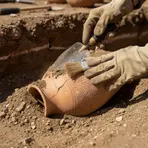
- The archaeologists worked tirelessly to unearth ancient artifacts buried deep beneath the soil.
- unearth the truth
- unearth evidence
- unearthed the fact
Loading YouTube…
Watch on YouTubeHe he continues to put his reporters undercover and to unearth people's true character.
- He he continues to put his reporters undercover and to unearth people's true character.
- If anything, you know, were to go wrong, they would be able to unearth it and fix it easily.
- That medication created a safer baseline in my system so I could unearth the deepest, deepest wounds and come out the other side.
- He says the person who asks what remarks were made about him and unearths nasty gossip even if it was kept secret, just upsets himself.
- You've had a fascinating career looking at this in depth for a long time, and we're going to unearth all of it.
- And if you know him on podcasts, you realize, like, he is genuinely trying to unearth some things that are genuinely disturbing for most people.
- I promise you, you will start to unearth something that's going to make you go.
- All of the Elon Musk's stuff about unearthing fraud during discovery is nonsense.
- When he was a student here doing his doctorate, he unearthed an electronic program which people could join.
Examples
-
My literature search did not unearth any more recent studies on the topic.
Academic text (2014) -
That medication created a safer baseline in my system so I could unearth the deepest, deepest wounds and come out the other side.
-
And that allows them to start to unearth everything that word means.
-
If anything, you know, were to go wrong, they would be able to unearth it and fix it easily.
-
And I have turned my research to unearth some secrets here.
-
The next three days were dedicated to unearthing quality and relevant resources.
Academic text (2014) -
At law firms, automated search software unearths paper trails among hundreds of thousands of legal documents.
Academic text (2012) -
Edna saw our documentation project as the perfect opportunity to unearth these portfolios.
Academic text (1998) -
He he continues to put his reporters undercover and to unearth people's true character.
-
After some rigorous research, Esquire has unearthed some other dressing-room demands:
Fiction book (2001)
Synonyms
 ∞
1.0
∞
1.0
To discover something while looking or by accident
 ∞
2.1
∞
2.1
To learn something you did not know, often by searching or asking
 ∞
1.0
∞
1.0
To find out about something for the first time, often by chance
 155
3.0
155
3.0
To find something while searching or by chance
 148
3.9
148
3.9
Search for and find someone or something after a lot of effort
 139
2.0
139
2.0
To take something out of the ground by digging
 122
3.0
122
3.0
Look for and find a person or thing, often with effort
 28
5.8
28
5.8
To dig in the ground to find or remove old objects, often by archaeologists
 21
3.4
21
3.4
Find and take out something that is hidden or forgotten
 13
6.7
13
6.7
To search carefully to find hidden facts or documents


 1
6.9
1
6.9
Find something after careful searching

Find something after searching carefully

To find something after a careful search

To look for something, often in books or old records

To find something without expecting it while searching
How Discovered

Surface Forms
Morphology
unearth = earth (semi-transparent) = un + earth
The investigative, figurative sense is a metaphorical extension of 'un-' + 'earth' (dig up), so learners who know 'earth' may not automatically infer the non-literal meaning.
Etymology
Unearth comes from un- ('remove') and earth ('ground' or 'soil'). So when you unearth a fact, imagine pulling it out of the ground to remember that you have discovered something hidden and brought it into the open.