

to dig out
 21
3.4
21
3.4

- phrasal verb
- /dɪɡ aʊt/
- That's when I went into my desk and dug out Phil's old letter, which I'd kept as a souvenir.
- dug out the old
- try to dig out
- dig yourself out of the hole
Loading YouTube…
Watch on YouTubeThey're the sort of things you can dig out of the data.
- They're the sort of things you can dig out of the data.
- Thousands and thousands of those tusks were dug out of the permafrost.
- And I just dug out this piece from the box and that's what I'm snacking on right now.
- And if you could go to a neutron star and dig out a chunk the size of a sugar cube, it would indeed weigh as much as the human race.
- His research shows how someone with a background in tech like Elon Musk has could dig out fraudulent billing.
- On Monday, I was able to use the tax laws of this country and my business acumen to dig out of the real estate mess.
- So the osteoclast crawls up the cell and starts digging out minerals to release to the body to do its function.
- And to to be able to, to work to help people dig out of that, you know, with no, no thought of compensation.
- I've had lots of students like this and you know, there is a joy in learning if you, if you can dig it out and you provide them with a little different perspective.
- But I'm also already digging out of it.
Examples
-
You never know when your list will help you dig out of a writing slump.
Blog text (9) -
I dug it out from under the house.
-
And teach 'em, Sarah, teach 'em never to come over here and dig these records out.
-
I told you to go behind the words and dig out the truth.
Fiction book (1992) -
Both boys dug it out by hand and opened the lid.
Fiction book (2000) -
Well, speaking of Milton, I think I will dig out a copy of his finest work.
Blog text (9) -
Surprising what you can dig out of books if you read long enough, isn't it?
Fiction book (1992) -
Thousands and thousands of those tusks were dug out of the permafrost.
-
Once into the trailer, he dug out the peanut butter and began daubing it on a slice of bread.
Fiction book (1992) -
Sarah rummaged through her knapsack and dug out a clipping from the neighborhood newspaper.
Synonyms
 912
1.0
912
1.0
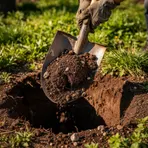
To move earth with a tool to make a hole
 139
2.0
139
2.0
To take something out of the ground by digging
 28
5.8
28
5.8
To dig in the ground to find or remove old objects, often by archaeologists
 21
3.9
21
3.9
Find and completely remove something harmful or hidden
 18
4.2
18
4.2
To dig up something buried in the ground
 13
6.7
13
6.7
To search carefully to find hidden facts or documents
 5
2.7
5
2.7
To take something out by picking it up, often carefully or with a tool
 1
5.8
1
5.8
To take something out of the ground after it is covered

To dig up roots or stumps from the ground

To dig up and remove plants or roots from the ground
Antonyms


How Thorough

Surface Forms
Morphology
The sense 'to find or retrieve something that has been buried, hidden, or forgotten' follows directly from combining 'dig' (to remove earth or uncover) with 'out' (outward/away), where 'out' conveys extraction or removal. This verb+particle pattern is a common, compositional phrasal-verb construction and is likely inferable by a B1 learner who knows both constituents.
Etymology
Dig out also comes from the idea of searching through boxes or drawers to find something hidden or forgotten. You imagine you dig through the pile and pull the item out, so it means 'to find or retrieve something that was buried, hidden, or forgotten'.