

to dig up
 139
2.0
139
2.0

- phrasal verb
- /dɪɡ ʌp/
- They're coming to look at, or help dig up, a pyramid in the heart of southeastern Europe.
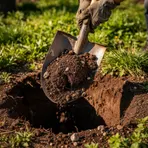
- farmers dig up potatoes
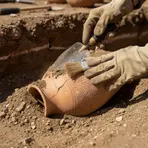
- archaeologists dig up ruins
- dig up mass graves
Loading YouTube…
Watch on YouTubeSo I think finally I'm going to dig up the potatoes.
- So I think finally I'm going to dig up the potatoes.
- So tailings, when you mine, you dig up rock, crush it up, kind of process it.
- Yeah, like I dug up these pipes and they are not new, right?
- However, the hydrocarbons that we've dug up so far almost all come from fossils.
- Ask yourself why the McCanns haven't asked Operation Grange to dig up the hill.
- And I thought, oh, those look good, I'd go and dig them up.
- On an asteroid, they can be much easier to dig up, and that's a straightforward way to get rich.
- And he was talking about like how he had to like get his, his his dig up his friends from under the rubble that were dead.
- So it wasn't the same damn color as when we dug it up and we were all stuck, like stuck out like sore thumbs.
- Like horse bones and like truffles, or like those weird little things that pigs dig up in the grounds?
- Leonardo DiCaprio finds out Simon Hansu's got this massive diamond hidden and at gunpoint takes him to dig up this diamond.
- How you know if somebody dug up the dirt and ate it?
- And so they would dig them up to eat the the retreats, as they're called.
Examples
-
Almost all the Malian terracottas are dug up by farmers and sold to make quick cash.
Academic text (1995) -
After the heavy rain, they decided to dig up the old pipe to check for leaks.
-
- I can probably dig one up.
-
Dig up whatever you can on the sale.
-
So I think finally I'm going to dig up the potatoes.
-
Suddenly I realized: these were the coins Victor and I had dug up in that garden.
Fiction book (1995) -
Then Victor got the idea that we should dig up the tiny garden out back, searching for treasure.
Fiction book (1995) -
He's going to investigate and dig up the evidence that presently exists.
-
Every morning I crawled out in the sun and dug up thirty turtle eggs to eat.
Fiction book (1996) -
In the fall, you should dig up the vegetables from your garden before the frost comes.
Synonyms
 912
1.0
912
1.0
To move earth with a tool to make a hole
 155
3.0
155
3.0
To find something while searching or by chance
 85
1.0
85
1.0
To move or dig material with a wide blade and handle
 38
4.4
38
4.4
To pull a plant out of the ground or force people to leave home
 34
8.1
34
8.1
To dig up a body from the ground for checking or burying again
 28
5.8
28
5.8
To dig in the ground to find or remove old objects, often by archaeologists
 21
3.4
21
3.4
Find and take out something that is hidden or forgotten
 18
4.2
18
4.2
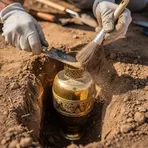
To dig up something buried in the ground
 1
6.3
1
6.3
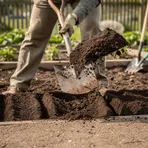
To dig and loosen soil, for example with a spade
 1
4.0
1
4.0
Pull a plant up from the ground so it cannot grow back

To dig up roots or stumps from the ground

To dig up and remove plants or roots from the ground

To dig in the ground or search through things with hands
Antonyms

How Thorough
- Specialized
34
8.1
 18
4.2
139
2.0
226
3.7
∞
1.0
533
2.7
18
4.2
139
2.0
226
3.7
∞
1.0
533
2.7
Surface Forms
Morphology
The meaning 'to find or remove something from the ground by digging' is directly and compositionally derived from 'dig' (to remove earth) plus the particle 'up' indicating removal/complete upward/outward motion. This verb+particle pattern is common in English and cross-linguistically paralleled, so a B1 learner who knows both constituents can readily infer the MWE meaning.
Etymology
The phrasal verb dig up comes from a simple picture: you use a shovel to dig into the ground and pull something up to the surface. So it means 'to find, remove, or recover something from the ground' and more loosely 'to discover' hidden things.