

to unearth
 18
4.2
18
4.2

- verb
- /ʌnˈɜrθ/
- But then, in 1907, just outside of Cairo, a local farmer unearthed two of them.
- archaeologists unearthed
- unearthed the skeleton
- unearthed during the excavation
Loading YouTube…
Watch on YouTubeTerrain to try to unearth these things and explode them.
- Terrain to try to unearth these things and explode them.
- You know, they're hidden under the rocks and maybe living between the crevices and unearthing them and and pushing them out in front and saying share.
Examples
-
Archaeologists unearth an ancient artifact during their excavation of the site.
-
And I unearthed it, and it was an ancient chest.
-
When the crystal was unearthed, no one could make the console inside work.
-
I unearthed a skull this afternoon on the site of what I suspect to be a Roman villa.
-
Now, if we are fortunate enough to unearth some Spanish metal relics, we'll know that Vargas and his men were here.
-
Setting out to dig one day, they unearthed the ancient skeleton of a Spaniard.
Academic text (2002) -
In the western United States, a group of archaeology students have unearthed the tomb of a 4,000-year-old Egyptian priestess.
-
Behind a pruned rosebush, he unearthed a rotted leather bag of silver coins.
Fiction book (1995) -
A search of every house unearthed dozens of copper and bronze grave goods, perfumed oils, fine linen, as well as 40 pounds of silver and more than ten pounds of gold.
-
Last summer, they unearth a hidden treasure while digging in their backyard.
Synonyms
 ∞
1.0
∞
1.0
To discover something while looking or by accident
 ∞
1.0
∞
1.0
To find out about something for the first time, often by chance
 155
3.0
155
3.0
To find something while searching or by chance
 139
2.0
139
2.0
To take something out of the ground by digging
 37
2.7
37
2.7
Remove a cover to show what is under it
 34
8.1
34
8.1
To dig up a body from the ground for checking or burying again
 28
5.8
28
5.8
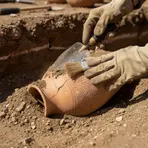
To dig in the ground to find or remove old objects, often by archaeologists
 21
3.4
21
3.4
Find and take out something that is hidden or forgotten
 5
8.6
5
8.6
Dig up a buried body to examine it
 1
6.3
1
6.3
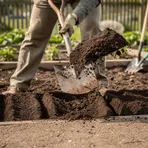
To dig and loosen soil, for example with a spade

To find something without expecting it while searching
Antonyms
How Found

Surface Forms
Morphology
unearth = earth (transparent) = un + earth
This is the literal sense formed by adding the productive negative/privative prefix 'un-' to the verb 'earth' meaning 'to put in the ground', so the meaning is directly derivable.
Etymology
Unearth comes from un- ('remove') and earth ('ground' or 'soil'). It keeps the simple, literal idea: to unearth an object is to dig it up and take it out of the ground.