

to stoke up
 1
5.4
1
5.4

- phrasal verb
- /stoʊk ʌp/
- Informal
- As the temperature dropped, we decided to stoke up the fire in the fireplace.
- stoke up the fire
Examples
-
Here, stoke up the fires, buddy.
-
Please stoke up the grill so we can start cooking the burgers.
-
Jake, stoke up the fire, man.
-
I'm gonna stoke up a fire in the waiting room.
-
So we are seeing an attempt to stoke up more interest in South Asia in the United States, a very worthy and overdue attempt.
Academic text (1995) -
"Storm's here, stoke up the fire!" someone shouted, and One-Eyed Kate opened the iron door to the old stove and struck a match.
Fiction book (1996) -
He'd stoke up the wood stove, snug his back close to it, and bask in the steam rising from his wet pants.
Fiction book (1994) -
After dinner, Larkin stoked up the cast-iron stove with peat and lit the oil lamps so that the tiny cottage seemed cozy and companionable.
Fiction book (1994) -
She shrugged and closed the door, returned to the bedroom for the lamp, then went to the kitchen to stoke up the banked fire in the cookstove, reminding herself that she must bank the coals again before the revived fire burned out.
Fiction book (1990) -
On chilly nights, I always stoke up the fire to keep our living room warm.
Synonyms
 177
4.3
177
4.3
To make feelings, arguments or actions stronger
 74
3.4
74
3.4
Make something greater in amount, speed or strength
 70
4.1
70
4.1
Make people feel excited and ready to act
 64
2.7
64
2.7
To make something more active, alert or interested
 57
3.4
57
3.4
To become more intense or make a situation more intense
 47
4.1
47
4.1
To increase something, especially its amount or speed
 39
3.8
39
3.8
To increase the level or strength of something, for example volume, production
 39
3.9
39
3.9
To make prices rise to a higher level, often quickly
 28
4.1
28
4.1
Make someone feel excited and full of energy
 26
4.2
26
4.2
Make a situation more urgent to force someone to act
 23
3.4
23
3.4
To raise prices or amounts by a lot
 12
5.9
12
5.9
To raise prices or rent suddenly by a lot
 9
3.5
9
3.5
Make someone wake up or feel more energetic
 9
1.3
9
1.3
Make an amount or level higher
 7
5.6
7
5.6
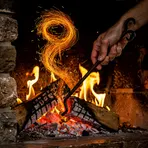
To add fuel or stir a fire to make it burn hotter
 7
6.7
7
6.7
To make someone want to work harder and faster
 2
4.8
2
4.8
To put extra fuel on a fire or make a disagreement worse
 2
4.4
2
4.4
Increase very quickly to a much higher level
 1
4.6
1
4.6
To make something faster or more active


 1
7.7
1
7.7
To become more active or exciting in a situation

Make an event like a party more lively and exciting

Make people more interested and eager about something
Antonyms

How Intense

Surface Forms
Morphology
The meaning is directly derivable from combining 'stoke' (to feed a fire or arouse/heighten) with the particle 'up' (to raise or increase), yielding ‘add fuel to’ or ‘increase intensity’. This is a regular verb+particle compositional pattern that is predictable and cross-linguistically common, so a B1 learner who knows both constituents should be able to infer the meaning.
Etymology
The phrasal verb stoke up comes from keeping a fire burning: to stoke a fire is to add wood or coal and move the embers so the flames grow, and up shows the fire becomes stronger. So, stoke up now means 'to increase' things like energy, heat, or excitement.