

siege
 139
6.8
139
6.8

- noun
- /siːdʒ/
- The Ethiopians were then held under virtual siege in Asmara for many months.
- lay siege to
- state of siege
- long siege
Loading YouTube…
Watch on YouTubeSo it laid, it laid dormant after the siege for a long, long time.
- So it laid, it laid dormant after the siege for a long, long time.
- If you're a Gazan, you're the most restricted, you're under siege.
- Our girls are under siege long before their teen years.
Examples
-
In spite of the epidemic, the Aztec repelled the Spanish siege for three months.
Fiction book (1992) -
The knights of the First Crusade laid siege to the city of Alexandretta for over a year.
-
Yet still the siege held fast.
-
Unknown to him, the siege was over and he had won.
-
This back and forth extended the siege for several days.
-
If he tried, a long drawn out siege would take months.
-
Right now, we are a nation under siege.
-
Good people of France, our country, our home is under siege.
-
The siege of Sarajevo was the longest in modern history.
-
The knights of the First Crusade laid siege to the city of Alexandretta for over a year.
Synonyms
 72
5.8
72
5.8
An action that stops people and goods entering or leaving a place, often during war
 2
7.5
2
7.5
Surrounding a place or army to cut off supplies and stop escape

 1
6.7
1
6.7
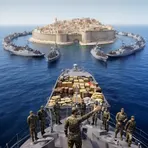
Soldiers or ships surround a place to stop supplies and force it to give up
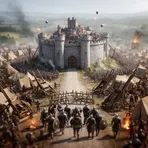
Surrounding a town or fort and attacking it to make the people inside surrender

A military action that surrounds a fort or city and cuts off its supplies
Antonyms


Compounds

- Literature
1
9.9
A seat at the Round Table for the knight meant to find the Holy Grail, deadly to others


A long 1863 military attack during the American Civil War when Union troops surrounded and captured Vicksburg

A 1781 battle that ended the American Revolution when British forces gave up after three weeks

A long attack that trapped British soldiers and residents in Lucknow during the 1857 uprising
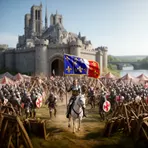
An English blockade of Orleans during the Hundred Years' War, ended by Joan of Arc in 1429
How Intense

Surface Forms
Etymology
The word siege comes from the old Latin root sedēre meaning 'to sit', because armies would 'sit' around a town and wait for it to give up. That's why a siege now means surrounding a place and cutting off supplies to force surrender.