
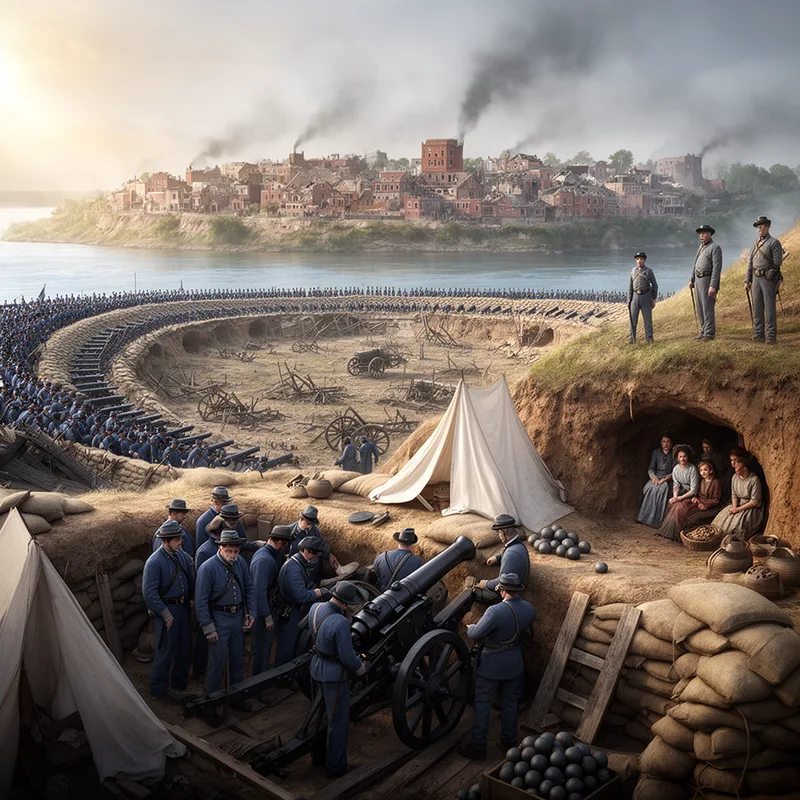
siege of Vicksburg
- noun
- /siːdʒ əv ˈvɪksbɜːrɡ/
- Union General Ulysses S. Grant led the siege of Vicksburg, which lasted for nearly seven weeks in 1863.
Examples
-
Regardless of the circumstances of their meeting, Gibbs made a massive purchase of property from Reuben Manning on July 11, 1863, just after Union General Ulysses S. Grant's successful siege of Vicksburg.
Academic text (2011) -
Walking back to the motel, he'd thought about the proud heritage of the city, how the people had endured the siege of Vicksburg with style and grace, and how far we'd come since that time.
Fiction book (1993) -
The siege of Vicksburg was a turning point in the American Civil War, resulting in the surrender of Confederate forces.
-
During the siege of Vicksburg, residents faced food shortages and difficult living conditions for weeks.
Synonyms

A key 1863 Civil War battle where Union forces surround and capture the city
Surface Forms
Morphology
The phrase is fully compositional: 'siege' (a prolonged military encirclement) + 'of' + the place name 'Vicksburg' straightforwardly denotes a siege that occurred at that town. A B1 learner who knows the constituents will therefore understand it refers to the military action against Vicksburg, even if they lack specific historical details.
Etymology
Siege of Vicksburg is the name of a real 1863 event when Union troops surrounded the town of Vicksburg and cut off its food and supplies for weeks. Because the city was trapped and had to 'surrender', the phrase brings to mind a long, deciding attack that forces a place to give up.

