
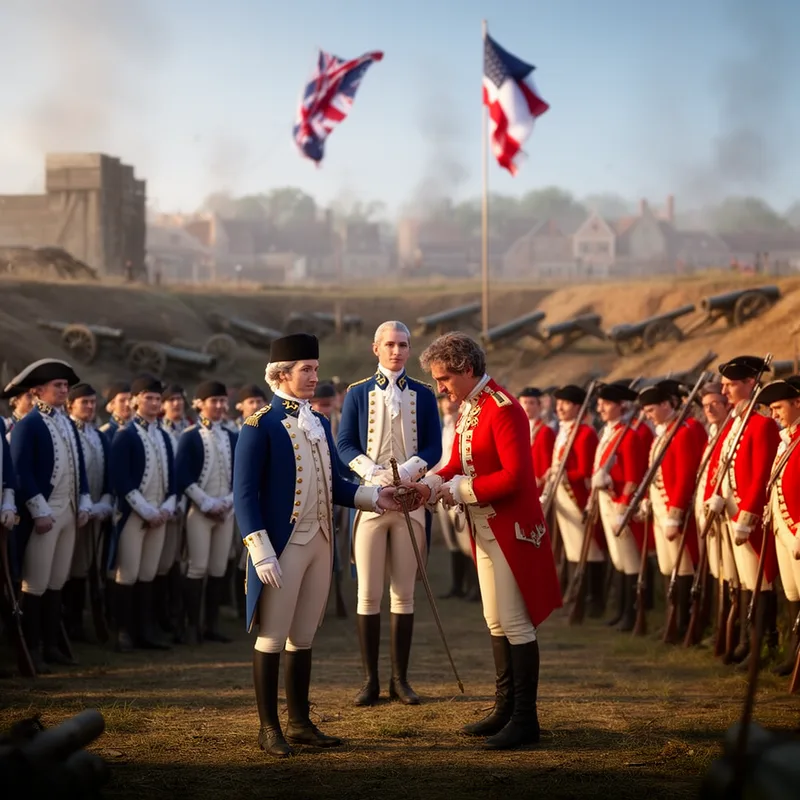
siege of Yorktown
- noun
- /siːdʒ əv jɔːrktown/
- Many historians consider the siege of Yorktown as the end of the Revolutionary War.
Examples
-
Many historians consider the siege of Yorktown the event that effectively ended the American Revolution.
-
Cornwallis surrendered to Washington after the siege of Yorktown in 1781.
-
The siege of Yorktown marked a decisive victory for the American and French forces.
-
The siege of Yorktown was a turning point in American history.
-
The British forces faced defeat after the prolonged siege of Yorktown in 1781.
-
General Cornwallis surrendered to the American and French troops at the siege of Yorktown.
-
The siege of Yorktown marked a turning point in the American Revolutionary War.
Synonyms

 12
6.7
12
6.7

A town in Virginia known for the final battle of the American Revolution in 1781
Surface Forms
Morphology
The phrase is fully compositional: 'siege' (a prolonged military encirclement) combined with the locative 'of' plus the place name 'Yorktown' denotes a siege that occurred at Yorktown. While the specific historical significance (final battle, surrender, 1781) requires background knowledge, the basic event meaning is directly derivable from the constituents and is cross-linguistically transparent.
Etymology
Siege of Yorktown was when American and French troops put a long siege around the town of Yorktown, surrounding and trapping the British and cutting off food and help for three weeks. Because the British had to 'surrender', this event is remembered as the important moment that helped 'end the war'.