

sea eryngium
- noun
- NSFW
- In the past, the roots of sea eryngium were thought to have medicinal properties.
Examples
-
The sea eryngium grows wild along many coastal sand dunes.
-
Many gardeners appreciate the sea eryngium for its drought resistance.
-
Botanists studied the unique adaptation of sea eryngium to salty environments.
-
The sea eryngium is known for its unique appearance.
-
In ancient times, people believed that the roots of sea eryngium could enhance romance and passion.
-
The striking sea eryngium thrives in sandy soil near the coast, adding a unique flair to coastal gardens.
-
Some herbalists still use sea eryngium roots today, drawing on its long history as a supposed aphrodisiac.
Synonyms

A plant with spiky blue-green leaves that grows on sandy coasts

A spiky plant with twisted leaves that stays green and grows on sandy beaches

A plant with spiny leaves and blue flowers often grown in gardens

A prickly plant with blue or purple flowers often called sea holly
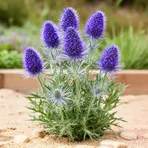
A spiny plant with blue or purple flower heads often grown in gardens
Surface Forms
Morphology
sea + Eryngium
This is a compositional noun compound where 'sea' specifies the habitat or association of the head noun 'Eryngium' (a type of flowering plant). A B1 learner who knows 'sea' and the botanical sense of 'Eryngium' can infer it denotes an Eryngium species found by the sea, so the meaning is directly derivable from its parts.
Etymology
Sea eryngium gets its name from sea, because it grows by the coast, and eryngium, an old name for a spiky plant. One popular story says people long ago used its strong roots as a medicine and even as an 'aphrodisiac', so today the name brings to mind a tough, spiky coastal plant once used for such remedies.

