
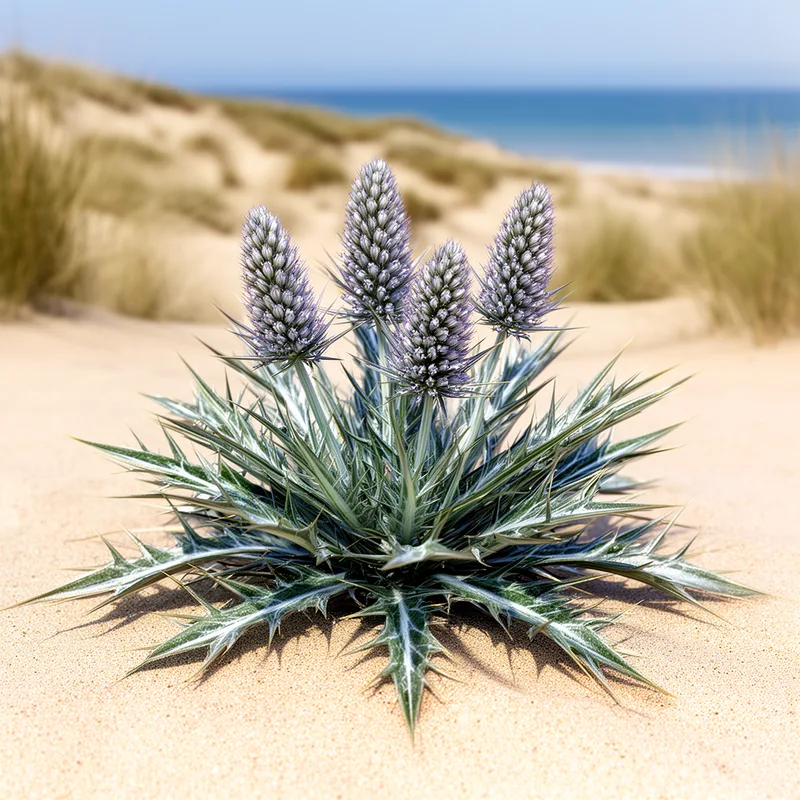
Eryngium maritimum
- noun
- UK
- On their seaside walk, they spotted clusters of Eryngium maritimum with its spiky blue-green leaves.
Examples
-
Gardeners sometimes cultivate Eryngium maritimum for its unique foliage and coastal hardiness.
-
The medicinal properties of Eryngium maritimum were valued in traditional herbal remedies.
-
The Eryngium maritimum thrives in coastal areas.
-
Have you seen the Eryngium maritimum growing by the beach?
-
Many coastal gardens feature Eryngium maritimum because of its striking blue-green leaves and resilience to salt spray.
-
During their beach hike, they admired the unique shapes of Eryngium maritimum growing among the sand dunes.
-
The plant Eryngium maritimum is known for its ability to thrive in dry, sandy soil along the coast.
Synonyms

A spiky plant with twisted leaves that stays green and grows on sandy beaches
A coastal evergreen plant with twisted spiny leaves that grows on sand dunes

A plant with spiny leaves and blue flowers often grown in gardens
Surface Forms
Morphology
Eryngium + maritimum
The name is a standard Latin binomial combining a genus ('Eryngium' — a spiny flowering plant) with an epithet that means 'of the sea' ('maritimum' ~ maritime), so the overall meaning — a coastal/species of Eryngium (sea holly) — is directly derivable from the parts. Although botanical Latin is specialized, the composition is transparent (genus + habitat epithet) and would be understandable to a learner who knows both constituents.
Etymology
Eryngium maritimum is a spiky coastal plant often called 'sea holly' because its blue-green, twisted leaves look like holly and it grows by the sea. Long ago people used its roots as a 'love medicine', so the plant is remembered for both its seaside home and this old use.

