

to sand off
 1
4.7
1
4.7

- phrasal verb
- Before applying the new finish, you should sand off the old paint.
- brushed the sand off
Examples
-
You need to sand off the rough edges of the wood to make it smooth.
-
He carefully sanded off the scratches to restore the table's surface.
-
Getting sand off that runway, OK?
-
You better brush that sand off.
-
While you were buying doll dresses, I sanded off your Barbie's face.
Blog text (16) -
Trimble and Malin-Boyce decided to clear the sand off the entire grave before removing the first body.
Academic text (2009) -
They start to brush the sand off the bottle... and out come this genie, and the genie says...
Synonyms
 62
1.2
62
1.2
To rub material off a surface with something hard or sharp
 42
2.7
42
2.7
Remove all covering or contents from an object so it is left bare
 27
3.5
27
3.5
To rub a surface with sandpaper to make it smooth
 9
3.7
9
3.7
To remove clothes or a cover completely and quickly
 5
3.4
5
3.4
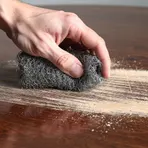
Come off a surface when something moves against it
 5
8.1
5
8.1
The surface wears away when something rubs or scrapes it
 5
6.7
5
6.7
To clean or shape a surface with a fast stream of sand
 3
5.2
3
5.2
To rub a surface with a small rough tool to remove something
 2
6.1
2
6.1
Wear a surface away slowly by rubbing, or make someone very tired
 1
5.1
1
5.1
To rub a surface with rough paper to make it smooth
 1
3.4
1
3.4
Remove a mark by moving a cloth or hand over it many times

To make a rough edge smooth by rubbing it with sandpaper
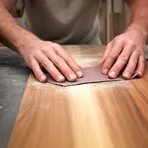
To make a surface smooth by moving something over it

Wear away the surface of something by rubbing or scraping

To wear away a surface slowly by rubbing
How Much

Surface Forms
Morphology
The meaning is directly derivable from the constituents: 'sand' (to smooth/remove a surface with sandpaper) combined with the particle 'off' (indicating removal) yields the sense 'remove the surface layer by sanding'. This verb + particle composition follows a common, transparent English pattern that a B1 learner who knows both words should be able to interpret.
Etymology
The verb sand off comes from the simple image of rubbing a surface with sand or sandpaper so the top layer is rubbed away and comes off. So, it means 'to remove the top layer of something by rubbing it with sandpaper'.