
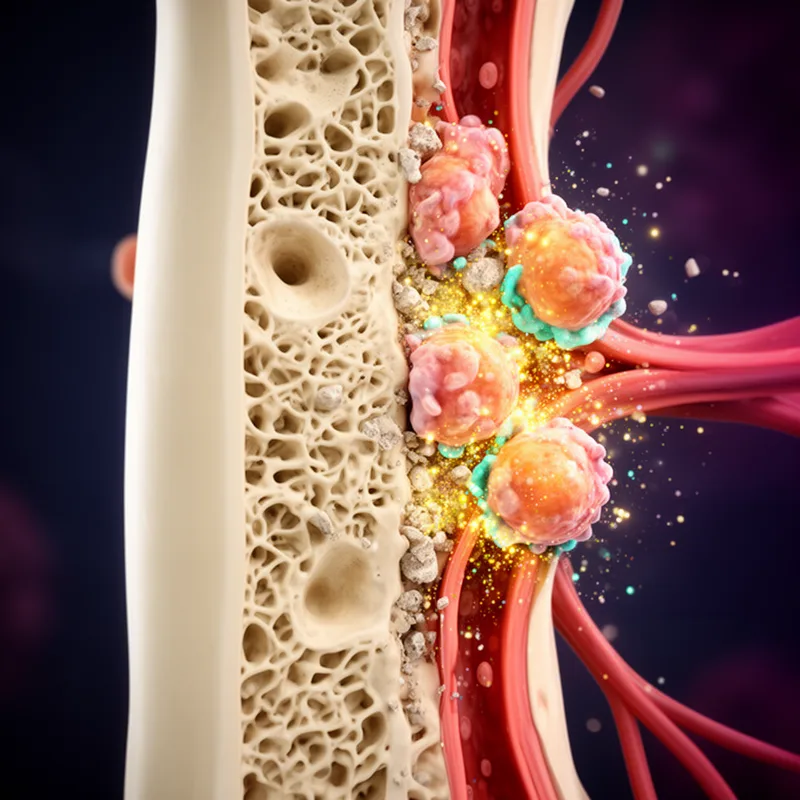
resorption


 1
9.6
1
9.6
- noun
- /rɪˈzɔrpʃən/
- Specialized
- Bisphosphonates are analogs of pyrophosphate that act to inhibit bone resorption by acting on osteoclasts or on osteoclast precursors.
- bone resorption
- osteoclastic resorption
- resorption inhibitors
Examples
-
About 50% of the patients treated with calcitonin will experience reduced markers of bone resorption turnover.
Academic text (2004) -
Bone mass reaches a plateau in our mid-30s, then steadily reduces as bone resorption becomes more dominant.
Academic text (2015) -
Minute holes from resorption are not filled in with new bone as they should be.
Academic text (2002) -
A major concern about high inspired oxygen concentration is the development of resorption atelectasis.
Academic text (2003) -
The orbital floor is usually thinned and can actually demonstrate complete resorption.
Academic text (2008) -
Normally, the resorption and formation processes are balanced, so there is no appreciable change in net bone mass.
Academic text (2004) -
The disadvantage to most biological fillers is resorption over time.
Academic text (2012) -
Unfortunately, there was a significantly higher rate of resorption in both instances, and autogenous fresh cartilage seems to be the preferred material.
Academic text (1995) -
Osteoblasts (bone formation cells) use these minerals in the constant cycle of bone resorption and formation.
Academic text (2002) -
Estrogen also plays a key role in bone health by slowing the resorption of old bone and promoting new growth.
Synonyms
 23
5.3
23
5.3
Breaking dead plants and animals into simpler material by bacteria and fungi
 19
4.1
19
4.1
A process in which a substance is broken into simpler parts by chemicals or living things
 8
6.7
8
6.7
A process in which a living part, like an organ, becomes simpler and less useful
 6
6.2
6
6.2
Something breaks into smaller pieces and falls apart
 1
6.7
1
6.7
A process where the body takes water or nutrients back in
Antonyms


Compounds

- Specialized
Loss of the bone around the tooth sockets after tooth loss or disease
Surface Forms
Morphology
Etymology
Resorption comes from the part re- ('back' or 'again') and the root sorb ('to suck in'), the same idea you see in absorb. So resorption is like the body 'sucking back' or taking material into itself, which explains the medical meaning of cells breaking down tissue and taking its parts.