

railway
 40
1.1
40
1.1

- noun
- /ˈreɪlweɪ/
- UK
- Our boss had taken us from the railway station in Mainz to her hotel.
- a railway station
- railway track
- railway noise
Loading YouTube…
Watch on YouTubeIs it a pneumatic railway in the South of England?
- Is it a pneumatic railway in the South of England?
- But here he held fast and the Allied forces could not take the railway.
- You notice that they, they make their way back to Britain, not by ship, but by the Trans Siberian Railway.
- But through force of will and effort, they've managed to change the cart onto a different set of railway tracks.
- Right now, the only way in and out of Ukraine is through roadways that are in the mountains and old defunct railways.
- They've made the gauge of the railways unique, so when you renew your stock, you have to go back to China.
- So this is when the London Underground and the other railway is not running through White Chapel or trains are not stopping in White Chapel.
Examples
-
We present evidence of an adverse effect of railway noise on blood pressure, especially for nighttime exposure.
Academic text (2012) -
I met him this morning at the railway station.
-
The company has to pay the government for the value of the land on the basis that the the railway had not been built.
-
But officers are working along the entire railway.
-
Before the operation of the railway, transportation between the coast and highland regions was limited.
Academic text (2012) -
So there are seven mainline railway stations in Paris.
-
She saw her husband at the railway yard.
-
When not in use, the railway tracks serve as an impromptu market.
Academic text (2008) -
In Europe, older settlement patterns persisted, and the railway was built to serve an already existing urban society.
Academic text (1999) -
I met him this morning at the railway station.
Synonyms
 303
1.0
303
1.0
A system of tracks and trains that carries people or goods
 32
2.5
32
2.5
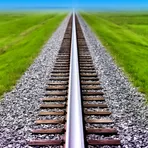
Two metal rails on the ground that trains run on
 16
2.8
16
2.8
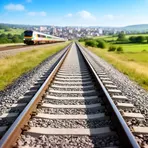
Tracks and the ground they sit on that form a route for trains
 3
2.1
3
2.1
A set of tracks that trains use to travel between places
 1
2.7
1
2.7
A company that runs trains to carry people or goods on tracks
Compounds


- UK

 1
3.8
1
3.8
A place with many train tracks where train engines and cars are kept and fixed

- Specialized
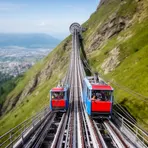
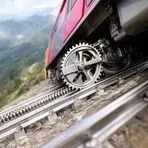
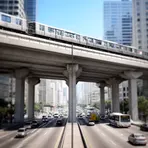
A railway for steep hills where a gear on the train fits into a toothed rail to prevent slipping

- Specialized
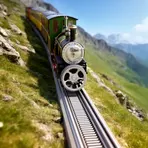
A steep railway with two cars joined by a cable that balance each other
- Specialized
A railway for steep hills where a gear on the train fits a central toothed rail to climb safely


A secret U.S. network that helped enslaved people escape to free states or Canada before the Civil War
Surface Forms
Morphology
Etymology
Railway comes from rail, a 'metal bar' for train wheels, and way, a 'path', which gives a clear image of two metal lines forming a road for trains. That's why a railway is the system of tracks and the route along which trains run.