

rail line
 16
2.8
16
2.8

- noun
- /reɪl laɪn/
- The train travels along the rail line that connects the two cities.
- a new rail line
- subway rail line
Loading YouTube…
Watch on YouTubeThey have built high speed rate rail lines to get people out of slow trains and into fast trains.
- They have built high speed rate rail lines to get people out of slow trains and into fast trains.
- And, you know, Fred would argue that that we should, we should just forget about all this stuff and just build more, more rail lines, you know, in, in certain places.
- And we found that there were a lot of interface with the fast rail line and with other elements.
Examples
-
With the rail lines throughout the South in tatters, it was decided to send them North by steamboat.
-
A new east-west rail line will emerge from below ground, connecting with the city's subways, light rail system, and buses.
Academic text (2007) -
I guess the King County light rail line is so new, no one can find it yet.
Blog text (22) -
The South had no industry or transportation like rail lines, as did the North.
Blog text (15) -
Original plans for the bridge included a subway rail line connection across the bridge.
Academic text (2006) -
Three of the five new rail lines are about half finished; that's the good news.
Blog text (19) -
You can see the main rail lines right here and where Tesla's rail lines are being connected.
-
After the opening of the first rail line in Japan in 1872, many businesses connected with railway transportation were established.
Academic text (1994) -
Simply electrifying a freight rail line increases capacity by about 15%.
Blog text (5) -
Engineers are leading the way in planning light rail, bus rapid transit systems, and even high-speed rail lines.
Academic text (2012)
Synonyms
 40
1.1
40
1.1
Tracks and other parts that trains run on
 32
2.5
32
2.5
Two metal rails on the ground that trains run on
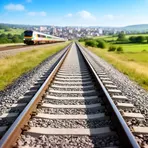 3
2.1
3
2.1
A set of tracks that trains use to travel between places
How Long
8
5.6
 7
3.2
16
2.8
7
3.2
16
2.8

 1
3.9
1
3.9
- Specialized
10
7.0
- Specialized
2
6.7
Surface Forms
Morphology
The meaning 'a set of railroad tracks forming a route for trains' is directly and compositionally derived from combining 'rail' (relating to railways) with 'line' (a route or linear formation). This noun phrase is a common, literal collocation with clear cross-linguistic equivalents (e.g. 'línea férrea', 'voie ferrée'), so a B1 learner who knows the constituents should readily understand it.
Etymology
Rail line comes from the simple image of long metal rails laid in a straight line across the ground to carry trains. So rail line today means the tracks and the ground that support them, or 'a route for trains'.