

psychogalvanic response
- noun
- /ˌsaɪkoʊˈɡælvənɪk rɪˈspɒns/
- Specialized
- When he was asked a difficult question, his psychogalvanic response indicated increased anxiety.
Examples
-
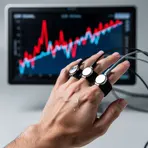
The device tracks your psychogalvanic response to monitor emotional arousal.
-
Researchers observed a significant psychogalvanic response in participants.
-
The psychogalvanic response is often measured in experiments on stress.
-
The psychogalvanic response was measured during the experiment.
-
During the anxiety-inducing test, the participants' psychogalvanic response showed significant variations.
-
Researchers recorded the psychogalvanic response to assess how stress affects electrical skin properties.
-
The subject's psychogalvanic response increased as the questioning grew more intense.
Synonyms
 7
8.7
7
8.7

A change in the skin's small electric signals that show stress or anxiety
 1
6.2
1
6.2
Change in the skin's tiny electrical activity when you feel stress or strong emotion

A change in the skin's electrical activity when a person feels stress or strong emotion

A change in the skin's electrical signal when someone feels stress or strong emotion

A change in the skin's electric signals when a person feels stress or anxiety

A change in small electrical signals in the skin when a person feels stress or anxiety
Surface Forms
Morphology
psychogalvanic + response
The compound is compositionally interpretable: psycho- (mind/psychological) + galvanic (relating to electrical activity) + response yields an electrical reaction linked to psychological states, so the overall concept is derivable from the parts. However, the constituent 'galvanic' and the rare coinage 'psychogalvanic' are technical and unfamiliar to a B1 learner, and the precise physiological sense (skin conductance vs. other measures) is specialized, so the expression is not fully predictable without prior exposure.
Etymology
Psychogalvanic response comes from the parts psycho, meaning 'mind', and galvanic, a word taken from a scientist who studied electricity in living bodies. Imagine your mind causing tiny electric changes on your skin when you feel nervous. So the term means those small, measurable skin changes that show 'stress' or 'anxiety'.