
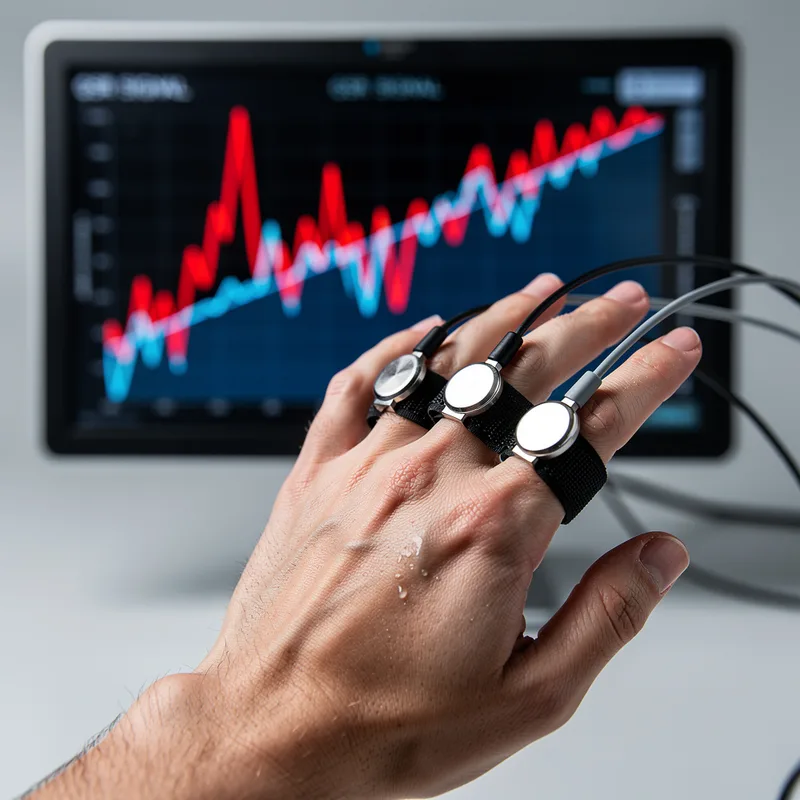
GSR
 7
8.7
7
8.7

- noun
- /ˌdʒiːˌɛsˈɑːr/
- Specialized
- In one embodiment, when the interactive application detects a decrease in galvanic skin resistance (GSR), possibly indicating that the user's hands are sweating, then the interactive application could initiate a cooling feedback at the controller.
- galvanic skin response (GSR)
- skin conductance (GSR)
Loading YouTube…
Watch on YouTubeSo he hooks up his polygraph with like a GSR or the galvanic skin response thing that measures moisture, right?
- So he hooks up his polygraph with like a GSR or the galvanic skin response thing that measures moisture, right?
Examples
-
To evaluate the effects of anxiety, the researchers conducted a GSR test on the participants as they watched a horror movie.
-
The psychologist monitored the patient's stress levels during the session using a GSR device that measured skin responses.
-
The lab took another look and found GSR on the inner lining of the right glove.
-
Heart rates and GSR were assessed, and subjects were given correct or false feedback regarding their physiological reactions to the sounds.
Academic text (1995) -
All subjects are connected to skin electrodes to measure their galvanic skin response (GSR).
Academic text (1999) -
Involuntary reflex EMG, GSR/EDA, temperature, and heart rate change responses are recorded for instant statistical comparison between sets of neutral and hot pictures.
Academic text (2006) -
Before using the AFT for this stage, it is recommended that the GSR be utilized in maybe 20-minute sessions where individuals seek to allay anxiety and stress.
Academic text (1990) -
It appeared that patients reacted with a Galvanic Skin Response (GSR) — of lie-detector fame — to photographs of faces of familiar persons.
Academic text (2009) -
GSR - galvanic skin conduction - is associated with pleasant and unpleasant olfactory stimuli and affect intensity (full range of emotions and discerning of truth).
Academic text (1999) -
The orienting reflex involves depression of the cortical alpha rhythm and increases in GSR, pupil dilation, cephalic vasodilation, and peripheral vasoconstriction.
Academic text (1995)
Synonyms
 1
6.2
1
6.2
Change in the skin's tiny electrical activity when you feel stress or strong emotion

A small change in the skin's electric signals when someone feels stress or strong emotion

A change in the skin's electrical activity when a person feels stress or strong emotion

A change in the skin's electrical signal when someone feels stress or strong emotion

A change in the skin's electric signals when a person feels stress or anxiety

A change in small electrical signals in the skin when a person feels stress or anxiety
Surface Forms
Etymology
The word GSR stands for galvanic skin response. The part galvanic comes from a root about 'electricity', so GSR names the small electrical change in your skin when you feel stress or strong emotion, which is why scientists use it to measure reactions. Think of galvanize, which means 'to shock into action' and shares the same idea, and that's why GSR is used to detect emotional responses.