
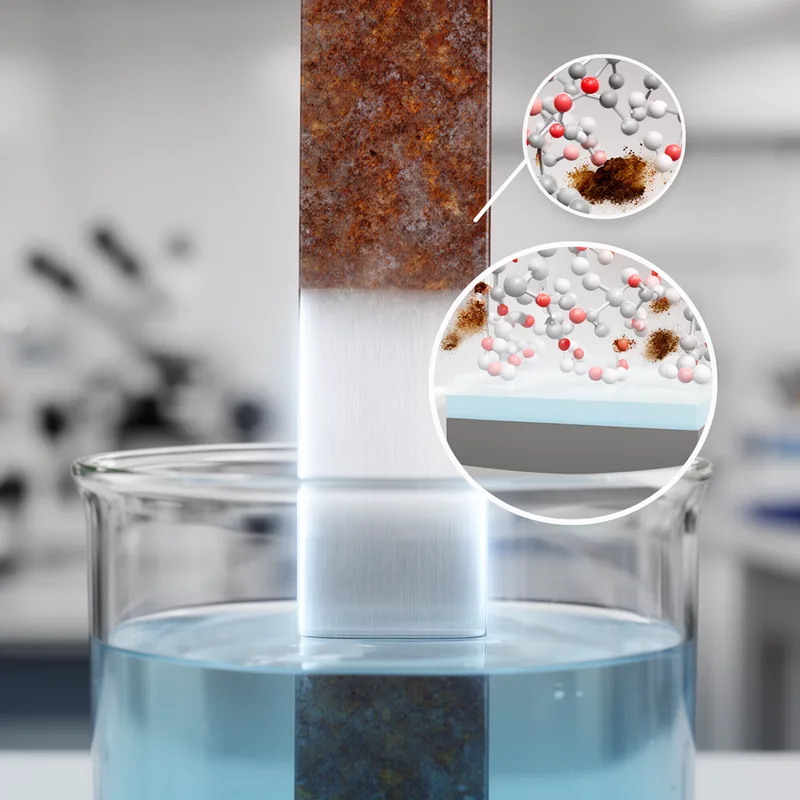
passivation


 1
7.5
- noun
- /ˌpæsɪˈveɪʃən/
- Specialized
- We found out that single laser pulses with both nano- and femto-second laser sources did not harm the surface passivation on SiO2 + a-Si:H hardmask samples.
- electrode passivation
- damage to the passivation
- passivation quality
Examples
-
The passivation of the metal surface helps prevent corrosion and extends the lifespan of the material.
-
The advantages of the solution oxidation process are simplicity, low cost, and rapid passivation of the Co(P).
Academic text (1998) -
The microscopic analysis was then followed by a study of the impact of patterning on the passivation quality on a macroscopic scale.
Academic text (2018) -
This allowed us to study the effect of laser damage on the passivation quality with increasing fluence values and decreasing spot-to-spot distance.
Academic text (2018) -
In silicon heterojunction solar cells, passivation is achieved by means of a few nanometers-thin hydrogenated amorphous silicon (a-Si:H) film.
Academic text (2018) -
This amorphous silicon signal is similar to the reference spectra of the SiO2 sample without the top a-Si:H mask, and it could be attributed to a-Si:H (i+n) passivation and the base contact layer below the SiO2 layer.
Academic text (2018) -
The passivation treatment made the alloy less reactive and more resistant to environmental damage.
-
In semiconductor manufacturing, passivation creates a protective layer that enhances device performance.
How Reactive
- Specialized
110
3.0

- Specialized
17
4.0
- Specialized
1
7.5
- US
25
3.9
Surface Forms
Morphology
Etymology
The word passivation comes from passive, which originally meant 'to be acted on' or 'not active'. So in materials, passivation is the process of making a metal surface 'not active' by forming a thin protective layer that helps stop rust and corrosion.