
to passivate
- verb
- /ˈpæsɪˌveɪt/
- Specialized
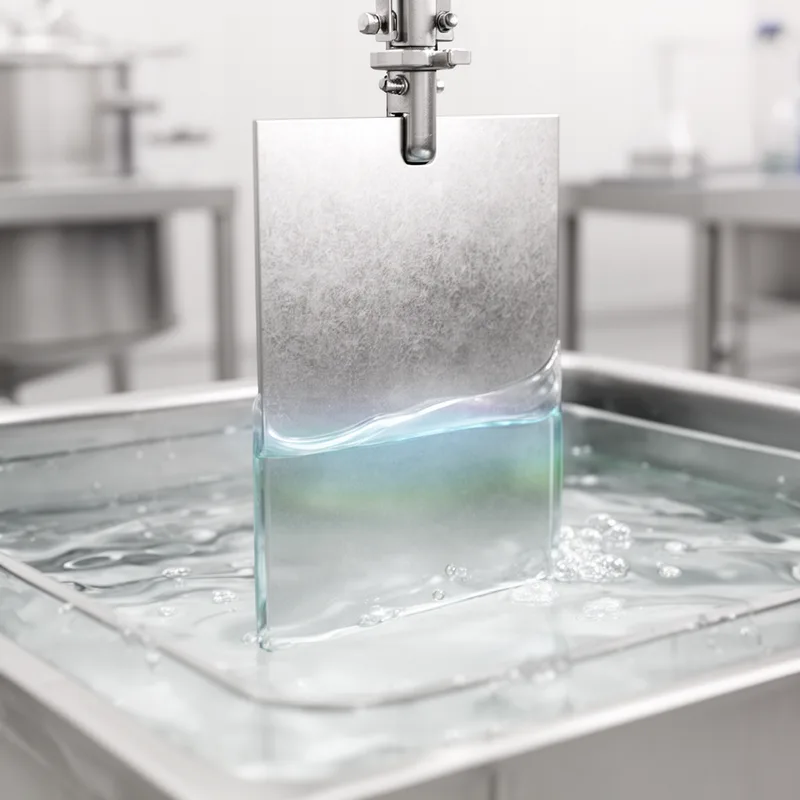
- Clean room tables with a chemically passivated, electropolished stainless steel surface reduce contamination and ensure clean room compatibility.
- passivating oxide layer
Examples
-
At this pH, the steel is no longer passivated and corrosion begins (Figure 3).
Academic text (1997) -
Furthermore, silicon dioxide is a good (but not perfect) barrier to the diffusion of impurities at fabrication temperatures as well as at operating temperatures, so that it passivates the underlying structures.
Academic text (1993) -
Engineers must develop methods to passivate the device and protect it from the conducting fluid.
Academic text (1994) -
However, a film grown too thick may lose its passivating properties because of stress-induced effects.
Academic text (1998) -
Hydrogen in the films partially passivates dangling carbon bonds within the films.
Academic text (1996) -
Unfortunately, dissolved salts in the contained water can penetrate through hardened concrete and destroy this passivating layer.
Academic text (1998) -
Rebars are naturally protected within new concrete by the highly alkaline (passivating) environment (pH of 12-13).
Academic text (1997) -
At room temperature, the accumulating halogens passivate the surface by tying up the dangling Si bonds, thereby rendering the surface chemically inert.
Academic text (1998) -
Our results strongly indicate that an oxide layer 50 thick is required for acceptable adhesion of polyimide because it provides a passivating film that prevents the reaction of the polyamic acid with Co.
Academic text (1998) -
Engineers must develop methods to passivate the device to protect it from chemical reactions caused by the conducting fluid.
Synonyms

 105
2.8
105
2.8

To cover something with a thin layer of a substance
How Reactive
- Specialized
47
3.7

- Specialized
7
5.5
- Specialized
- US
197
3.7
Surface Forms
Morphology
Etymology
Passivate shares the root with passive, from Latin pass- meaning 'able to be acted on'. So to passivate metal is to make its surface 'passive' or less active, usually by giving it a thin protective layer.