

to orbit
 126
3.9
126
3.9

- verb
- /ˈɔːrbɪt/
- Specialized
- We will not allow more than X satellites to orbit Earth at once.
- planets orbit stars
- stars orbit the center
- orbit the Earth
Loading YouTube…
Watch on YouTubeI don't know Earth and Mars, one orbiting faster than the other.
- I don't know Earth and Mars, one orbiting faster than the other.
- There's a few hundred that orbit in the Goldilocks zone.
- Well, suppose that you actually have two stars that are orbiting each other, OK?
- So it is an incredibly dense planet orbiting very close into its star.
- Well, actually, the Earth and the Sun orbit around a common centre of mass.
- And those two neutron stars will orbit each other diligently.
Examples
-
The moon and Earth each orbit their common center of mass.
-
There are 7 Zeus satellites orbiting Earth.
-
In the same way most stuff will just orbit a black hole.
-
Well, actually, the Earth and the Sun orbit around a common centre of mass.
-
Jim watched in amazement as the space station continued to orbit around the Earth.
Fiction book (2000) -
Apollo 10 will just be orbiting the moon.
-
You'd need a satellite and launch capabilities to orbit it.
-
Such early black holes are probably still orbiting in our own galaxy.
Academic text (2011) -
The system also has three smaller terrestrial planets and two gas giants orbiting the star.
-
The satellites will orbit the Earth at a height of 300 kilometers.
Synonyms
 210
1.8
210
1.8
To move around something in a circle
 88
3.0
88
3.0
Move around something following a curved path
 10
3.6
10
3.6
Move in a circle around a central object, like planets around the Sun
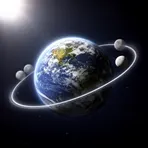
Move around another object in a curved path
Antonyms


Phrasal Verbs
- Specialized
8
4.3
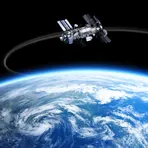
Move in a curved path around Earth like a satellite or spacecraft
Compounds
- Specialized
3
6.9
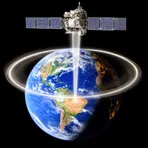
A path around Earth where a satellite goes once every 24 hours and stays above the same place each day
- Specialized

 1
6.1
1
6.1
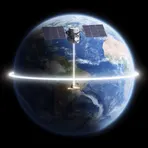
An orbit around Earth where a satellite stays above the same point on the equator
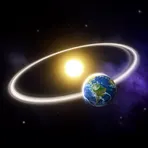
- Specialized
A path in space that a planet or moon follows around a bigger object such as a star

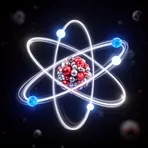

- Specialized
The angle that shows how tilted an orbit is to Earth's path around the Sun

How Fast
17
2.6
 227
1.0
227
1.0
- Specialized
126
3.9
10
3.6
144
3.0
210
1.8
Surface Forms
Etymology
The verb orbit comes from Latin orbis ('circle') and orbita ('path' or 'track'); it originally described moving in a wheel's track. So to orbit is to move in a curved path around a planet, star, or other body.