
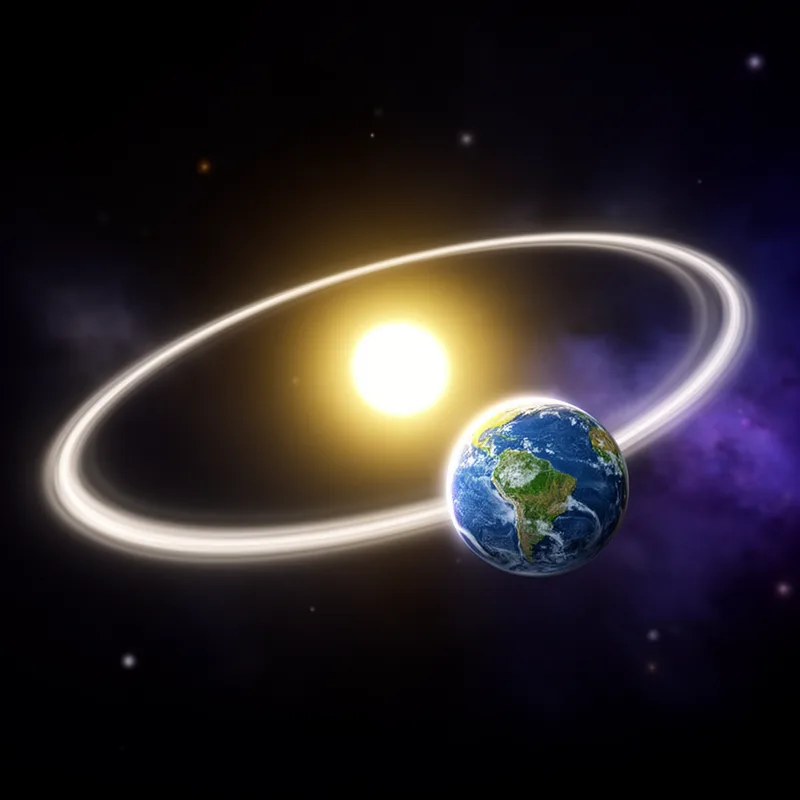
celestial orbit
- noun
- /səˈlɛstʃəl ˈɔrbɪt/
- Specialized
- The moon follows a predictable celestial orbit around the Earth, completing a full cycle every 27.3 days.
Examples
-
Astronomers use precise calculations to determine the celestial orbit of satellites around the Earth.
-
The scientists studied the celestial orbit of the newly discovered exoplanet to understand its behavior in relation to its star.
-
The nickel will not bend nor deform, and will stay somewhere in this celestial orbit versus flying across the room to parts unknown, or becoming one with the drill bit.
Blog text (29)
Synonyms

 378
4.0
378
4.0

A curved path that a planet or satellite follows around another body


 1
5.3
1
5.3
Movement of one object around another in space, like a planet around a star
Surface Forms
Morphology
The meaning is transparently composed from 'celestial' (relating to stars/planets) and 'orbit' (a curved path), so the phrase simply denotes the path taken by a celestial body. This is a regular noun + noun modifier pattern found in many languages, so a B1 learner who knows both constituents will readily infer the intended meaning.
Etymology
Celestial orbit creates a simple picture: the word orbit is a path, so imagine a planet, moon, or satellite moving again and again on the same route around a larger body, like a car on a round track. That's why it means 'the path' a body follows as it goes around a star or planet.