

mastodon
 7
9.3

- noun
- /ˈmæstəˌdɒn/
- In 2016, researchers discovered a well-preserved mastodon skeleton in a Wisconsin bog.
- mastodon bones
Examples
-
A site in the Saltville Valley in southwestern Virginia that yielded a mastodon bone and apparent artifacts that date to 17,000 B.P.
Academic text (2006) -
The discovery of Kenosha's mammoths began in 1990 when avocational archaeologist Dave Waison overheard old-timers talking about some mastodon bones that used to be on display at the county courthouse.
Academic text (2002) -
Over the next several weeks, Old Horry found more mastodon bones.
Academic text (2017) -
"I bought the fossilized mastodon tooth my grandson wanted," said another.
Academic text (1998) -
The Lozier family of Hyde Park, New York, found a 120,000-year-old mastodon in their backyard while they were expanding their pond.
Academic text (2001) -
Thirty-six species, including the mastodon, mammoth, and saber-toothed tiger, went extinct.
Blog text (20) -
The Massachusetts Puritan Cotton Mather believed that mastodon fossils found near Albany, New York, in 1705 were those of giants who had perished in Noah's flood.
Academic text (2005) -
A farmer accidentally unearthed a mastodon jawbone while plowing his field in Michigan.
-
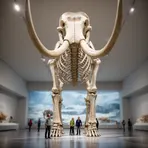
The museum's exhibition featured a life-sized model of a mastodon alongside its fossilized remains.
Synonyms
 7
9.9
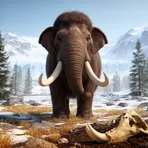
A large extinct animal like an elephant with long tusks that lived long ago

 1
9.9
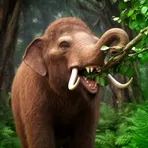
An extinct animal like an elephant with pointed back teeth for eating leaves
 1
9.9
A very large animal like an elephant that lived long ago and is now extinct
Compounds
 1
9.9
A large extinct elephant-like animal with cone-shaped teeth that lived in North America long ago
Surface Forms
Etymology
Mastodon comes from Greek parts masto- meaning 'breast' and -odon meaning 'tooth'. Early scientists thought its large molar teeth had nipple-like bumps, so they called it 'breast-tooth', which is why a mastodon is the big, extinct, elephant-like animal known for its special teeth.