
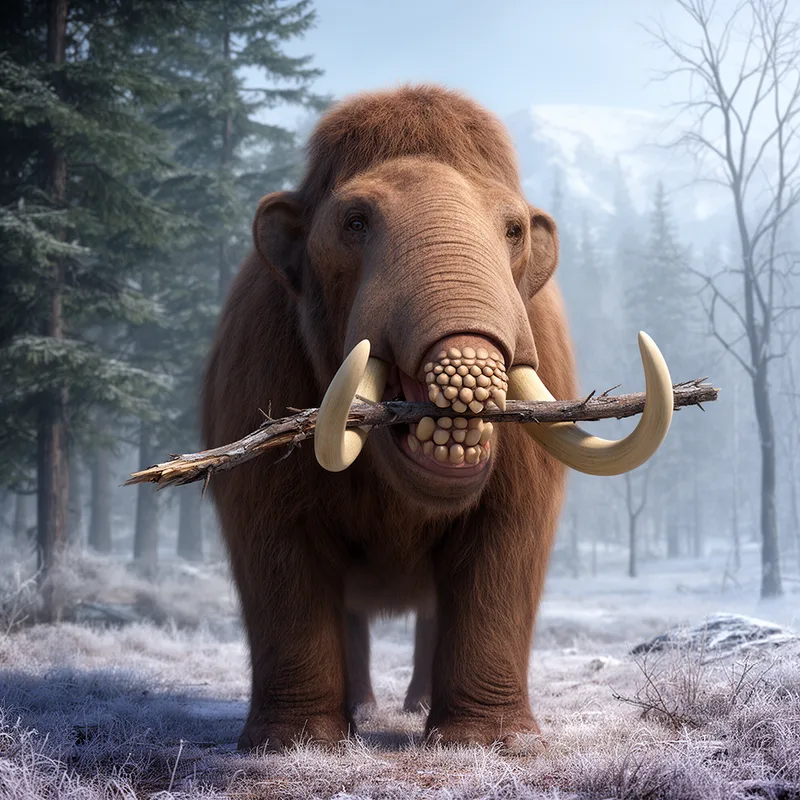
American mastodon


 1
9.9
- noun
- /əˈmɛrɪkən ˈmæstəˌdɒn/
- US
- Many fossils of the American mastodon have been discovered.
Examples
-
Unlike mammoths, the American mastodon had distinctive cone-shaped teeth.
-
The American mastodon roamed the forests of North America thousands of years ago.
-
Scientists discovered the remains of an American mastodon preserved in a peat bog.
-
The American mastodon was a large herbivore.
-
The American mastodon was one of the largest mammals that lived in North America during the late Pleistocene epoch.
-
Fossils of the American mastodon have been found in various locations across North America.
-
Scientists believe the American mastodon roamed the forests and grasslands of North America before becoming extinct.
Synonyms

A large extinct animal like an elephant that lived in North America

A large extinct animal like an elephant with long tusks that lived in North America during the Ice Age
Surface Forms
Morphology
The meaning 'a mastodon from America' is directly and compositionally derived from 'American' (of the Americas) + 'mastodon' (an extinct mammal); a learner who knows both words can infer it refers to mastodons that lived in America. This adjective + noun pattern indicating origin or distribution is a regular, cross-linguistic construction, making the phrase transparent to a B1 learner.
Etymology
American mastodon gets its name from the animal's tooth shape and where it lived. People called it mastodon because its teeth had cone-like bumps that looked like 'breasts', and they added American to show it came from 'North America'. So the name points to a large, now extinct animal from North America.