

to immerse
 2
4.9
2
4.9

- verb
- /ɪˈmɜrs/
- The objects are too familiar and too immersed in meaning for that.
Loading YouTube…
Watch on YouTubeThe way they clearly demarcate themselves from the states or the soup in which they are immersed.
- The way they clearly demarcate themselves from the states or the soup in which they are immersed.
- Now the key point, crucial point is that you have to think of these bits, this quanta of gravity, not as things immersed in space.
- You're fully immersed and it's actually so, so real that you move within the six sided cave for about two minutes.
- The where they clearly demarcate themselves from the states or the soup in which they are immersed.
Examples
-
We were immersed in a green light.
Fiction book (1992) -
One is surrounded, immersed in a cold shock of another medium foreign to the self, and where one could not stay.
Fiction book (1991) -
It's losing the view of a spectacular storm immersed in a sea of dust.
Academic text (1999) -
"By yourself?" He looked up from the folder of documents in which he was immersed.
Fiction book (1993) -
We are currently immersed in a "local fluff" cloud which is of a very low density.
Blog text (28) -
But making justice a reality is hampered by the web of systematic injustices in which each of us is immersed.
Academic text (1998) -
But near the riverbank, it is quieter, murmuring more as though immersed in itself.
Fiction book (2000) -
The issue of unfamiliar musical knowledge acquisition raises the question of how and to what extent youngsters, being immersed in their specific cultural music system, are able to fully grasp an unfamiliar one.
Academic text (2016) -
The widespread diffusion of American movies occurred precisely at a time when Mexican postrevolutionary society was immersed in a strong nationalistic movement, which began around 1920.
Academic text (2017) -
She decided to immerse the vegetables in boiling water to quickly blanch them.
Synonyms
 143
4.8
143
4.8
To completely cover or hide something so it disappears
 141
1.0
141
1.0
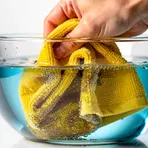
Make something very wet by putting it into water or other liquid
 41
4.5
41
4.5
To surround something completely, like fog or darkness
 40
5.1
40
5.1
To cover something completely and suddenly, often by fire or water
 31
1.0
31
1.0
Cover completely with liquid, for example food in sauce
 21
4.6
21
4.6
Cover something completely so it cannot be seen
 15
4.6
15
4.6
To cover completely so it cannot be seen, often by water or strong feeling
 14
4.4
14
4.4
Fill something completely with a liquid or a strong feeling
 12
6.8
12
6.8
To fill something with light or strong feeling
 6
5.6
6
5.6
To cover something completely, as if by a blanket or mist
 6
5.0
6
5.0
To put something completely under water or to become very involved in an activity
 5
2.8
5
2.8
Completely swallow something like land or light
 3
7.4
3
7.4
To fill something completely with a liquid or chemical


 1
8.0
1
8.0
To cover something completely, often by surrounding it with cloth or paper
 1
7.3
1
7.3
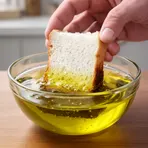
To put something under the surface of water
 1
8.8
1
8.8
To soak something completely in liquid

Completely surround something, often in a round shape like a ball

To spread a substance all around something, like light or scent
Antonyms

Phrasal Verbs

How Enclosed
21
4.6
 40
5.1
2
4.9
34
4.9
41
4.5
∞
1.7
40
5.1
2
4.9
34
4.9
41
4.5
∞
1.7
Surface Forms
Morphology
immerse = merge (semi-transparent) = im + merse
Meaning 'enclose or envelop completely' is a near extension of the literal 'put into' sense and fits the im- + merse structural analysis, but the unfamiliar root form limits full transparency.
Etymology
Immerse comes from a Latin verb immergere, with im- 'in' and mergere 'to dip', so it carries the image of being put inside or surrounded. Imagine fog or water closing all around you; that's why to be immersed is to be completely covered or surrounded by something.