

to go around
 49
5.1
49
5.1

- phrasal verb
- /ɡoʊ əˈraʊnd/
- Specialized
 :
flanquear
:
flanquear
- Our plan is to go around their forces to launch a surprise attack.
- go around the side
- go around the back
- go around the front
We, we, we saw this, this truck would leave this place, go around a mountain and drive through the snow and wait to ambush Americans.
- We, we, we saw this, this truck would leave this place, go around a mountain and drive through the snow and wait to ambush Americans.
Examples
-
"Just go around the back of this building, past the support facility, and you'll see the pen.
Fiction book (1990) -
- I'll be going around back a different way to try to surround them.
-
Listen, either I can go around you, or I can go through you.
-
You go around the other side.
-
Pull out and go around the corner.
Fiction book (1990) -
Go around and find out what's going on back there!
-
You go around, I'll distract him.
-
We'll head back and we'll go around; that's safer.
-
If you try to go around me and my family to get to him, you'll regret it.
Fiction book (1999) -
- Let's go around.
Synonyms
 60
5.0
60
5.0
To move to the side of something, often to gain an advantage
 46
1.1
46
1.1
To go on foot around the edge of something instead of through it
 21
2.3
21
2.3
Move in a round path around someone or something
 19
1.3
19
1.3
To go around something to get to the other side
 5
7.2
5
7.2
To move around the side of an enemy to attack from behind

Move around something or someone in a circle
Antonyms

How Indirect

Surface Forms
Morphology
The meaning 'to circulate among people' is directly and compositionally derived from 'go' (to move) combined with 'around' (around/about/among), yielding the motion sense of moving through a group. This motion-to-distribution mapping is common cross-linguistically and follows standard English particle-verb patterns, so a B1 learner who knows both constituents can readily infer the meaning.
Etymology
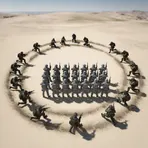
Go around comes from a battlefield picture: soldiers walk around the enemy's front to attack from the side or behind. So it means 'to move around the side of an opposing army' and avoid a direct fight.