
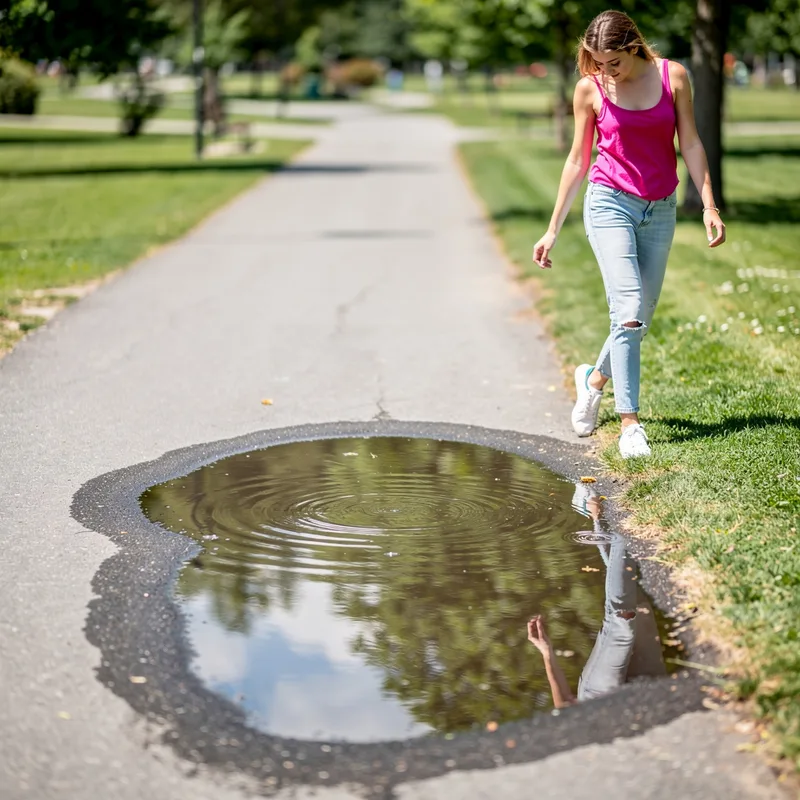
to walk around
 46
1.1
46
1.1

- phrasal verb
- /wɔk əˈraʊnd/
 :
rodear
:
rodear
- You could walk around it in an hour.
- walk around the house
OK, out, down, walk around the front of the vehicle.
- OK, out, down, walk around the front of the vehicle.
- I want to live like Robinson Caruso on an island that I can walk around.
- But imagine if you took an office building and every floor, you don't have to walk around the whole fucking God damn wall.
Examples
-
You know, they don't walk around on the streets wearing their pajamas.
-
There's not a lot to do on Long Island, so we'd walk around through the developments.
Fiction book (1992) -
OK, out, down, walk around the front of the vehicle.
-
Is it safe to walk around at night? - No.
-
Me and my friend Mark would just leave school two or three days a week, walk around the local parks.
-
The door was locked, so they walked around to the backyard and looked in the window.
Fiction book (1990) -
Please try to walk around the cones without touching them and stay inside the lines.
Academic text (1996) -
Mr. Waturi's attention is split between his call and Joe, who is walking around the office like a tourist.
Fiction book (1990) -
Escape Quantum is an adventure puzzle game where you walk around and have to find keys and cards to unlock doors.
-
We decided to walk around the lake to enjoy the beautiful scenery.
Synonyms
 210
1.8
210
1.8
To move around something in a circle
 88
3.0
88
3.0
Move around something following a curved path
 21
2.3
21
2.3
Move in a round path around someone or something
 19
1.3
19
1.3
To go around something to get to the other side
 16
4.4
16
4.4
To move along the edge of something
 10
3.6
10
3.6
Move in a circle around a central object, like planets around the Sun
 8
7.6
8
7.6
To walk around without a clear plan, often slowly and without much energy
 4
6.9
4
6.9
To walk around without a clear purpose


 1
9.9
1
9.9
To walk all the way around something, often as part of a religious ceremony

Move around something or someone in a circle

To walk slowly without a clear purpose

To travel around a place, usually on foot
How Mobile
819
1.0
 ∞
1.0
49
2.1
46
1.1
∞
1.0
49
2.1
46
1.1
- Informal
133
2.0
Surface Forms
Morphology
The meaning 'a leisurely or casual stroll' is directly derivable from combining 'walk' (to move on foot) with 'around' (in the vicinity/without a fixed destination); the particle 'around' signals movement in a general area rather than toward a goal. This compositional pattern is literal and cross-linguistically common, so a B1 learner who knows both constituents will readily understand the MWE.
Etymology
Walk around comes from the clear picture of going on foot around an obstacle: you choose to walk around a puddle instead of stepping through it. That's why it means 'to go around the edge of something rather than through it'.