

to go around
 63
2.4
63
2.4

- phrasal verb
- /ɡoʊ əˈraʊnd/
- There's enough cake to go around at the party, so everyone can have a slice.
- enough to go around
- blame to go around
Loading YouTube…
Watch on YouTubeThere's so much malevolence to go around.
- There's so much malevolence to go around.
- One of the things we know about the American legal system is there are not enough lawyers to go around to poor people in the US.
- I must say there's plenty of blame to go around for the unacceptable situation in North Korea today.
- Do you think there are enough acting jobs to go around in in?
- Right now there just aren't enough hearts to go around from people.
Examples
-
One of the things we know about the American legal system is there are not enough lawyers to go around to poor people in the US.
-
WOMAN 2: There's not gonna be any more food to go around.
-
The more people we allow in, the less water we have to go around.
Fiction book (2001) -
"It's a big country, and there are not enough troops to go around."
Academic text (2001) -
As the economy grows, there is more to go around for everyone.
Academic text (1993) -
There is plenty of blame to go around for this lack of preparation.
Academic text (1999) -
There aren't enough resources or energy to go around.
-
There's plenty of food to go around.
-
The droughts meant less feed to go around, and farmers had to take drastic measures.
Blog text (12) -
Even in astronomer-rich Tucson, it's tougher each year to find enough astronomers to go around.
Academic text (2000)
Antonyms

How Sufficient


Surface Forms
Morphology
The meaning 'to circulate among people' is directly and compositionally derived from 'go' (to move) combined with 'around' (around/about/among), yielding the motion sense of moving through a group. This motion-to-distribution mapping is common cross-linguistically and follows standard English particle-verb patterns, so a B1 learner who knows both constituents can readily infer the meaning.
Etymology
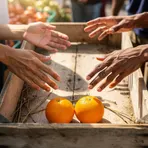
Go around comes from passing food or goods around a table so each person can have some. That image explains why it means 'to be enough for everyone'.