

to get over
 100
3.3
100
3.3

- phrasal verb
- /ɡɛt ˈoʊvər/
- To get over the stream, we built a small bridge with some fallen branches.
- get over the fence
- get over the wall
- help them get over
Loading YouTube…
Watch on YouTubeSo that's good for getting over trees and stuff.
- So that's good for getting over trees and stuff.
- That's how people actually get over to Pine Island.
- Like no light from this skylight gets over there and that's why it is still supple.
- I don't even know how it got over there.
- And so I think you getting over there and asking him, I think it's a pro move.
- And Andrew said to me, as we got over the training area, you see that mountain over there?
- But me and me and, you know, Danny would get over by the rest area.
Examples
-
The whole time we drove, I couldn't get over how the land changed.
Fiction book (1990) -
Cal, let's get over to those other two boats by the bridge.
-
You better get over here as fast as you can.
-
No, I think we better get over to the mine shop.
Fiction book (1999) -
You better get over there and collect some of that cash right now.
-
I just wanted to get over to that desk and sit down.
Fiction book (1990) -
That's how people actually get over to Pine Island.
-
But this is a brave little girl; she's determined to get over the bridge.
Fiction book (1991) -
He's thinking about how he's going to get over the border tonight.
Fiction book (1996) -
I free Quinn and tell him to get over to the infirmary to guard against infection.
Fiction book (1992)
Synonyms
 ∞
1.0
∞
1.0
To move past something or someone
 ∞
1.0
∞
1.0
To go across something from one side to the other
 270
3.0
270
3.0
Manage to move beyond a problem or a bad feeling
 102
3.1
102
3.1
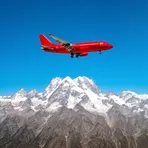
To move through the air above a place, for example a plane or bird
 80
2.1
80
2.1
Pass from one point to another during a journey or process
 53
1.8
53
1.8
Move from one side to the other, for example across a road or river
 51
3.0
51
3.0
To go straight across a place, for example through land or a crowd
 26
3.3
26
3.3
To move across a place, often above the ground
 16
5.6
16
5.6
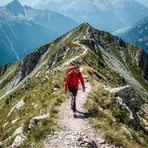
To move across land or water from one side to the other
 8
3.2
8
3.2
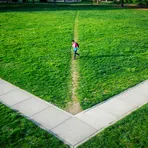
To go through a place like a park to make a shorter route
 1
2.2
1
2.2
To jump lightly from one side to the other using small jumps


 1
3.5
1
3.5
To pass above something usually using a bridge
 1
5.4
1
5.4
To walk with heavy steps across a large area
 1
8.0
1
8.0
To jump across an obstacle like a fence or wall

To cross something like a mountain or river
Antonyms

How Hard
6
6.3
 15
3.1
1
5.4
100
3.3
53
1.8
28
1.6
15
3.1
1
5.4
100
3.3
53
1.8
28
1.6
Surface Forms
Morphology
The sense 'to travel across / pass over' is a straightforward composition of a motion verb get (move/arrive) plus the particle/adverb over (across/on the other side). Although the provided single-word definitions list less relevant senses, a B1 learner who knows the common motion sense of 'get' and the spatial sense of 'over' will readily infer the MWE meaning, so it is transparent.
Etymology
Get over comes from the literal act of crossing something like a river, wall, or mountain: to get over an obstacle is to travel across or pass it, so the phrase means 'to travel across or pass over'.