
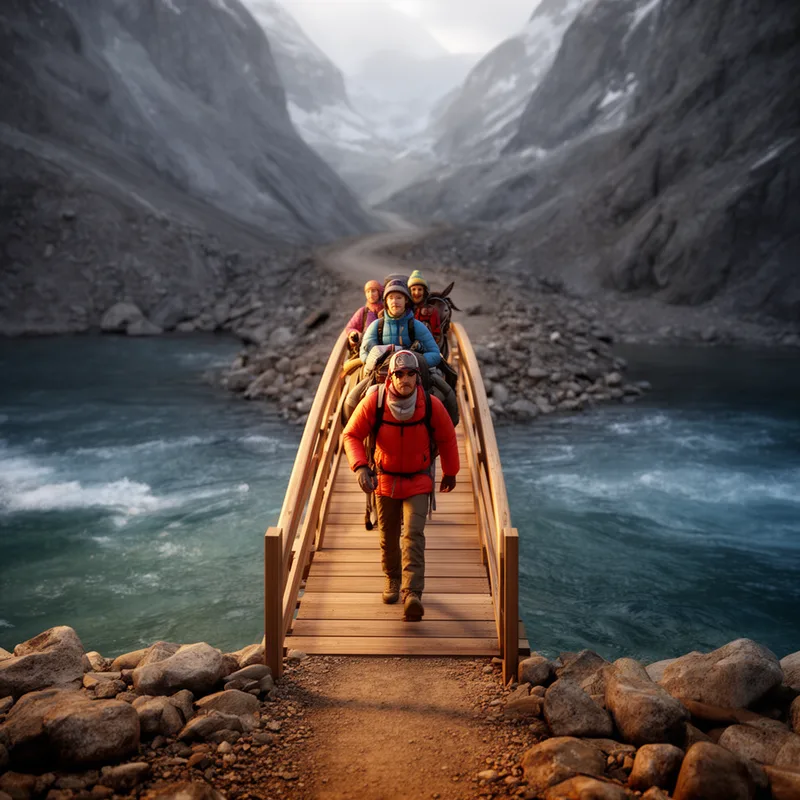
to overgo
- verb
- /ˌoʊvərˈɡoʊ/
- Archaic
- They watched the caravan overgo the narrow bridge at dawn as mist lifted.
Examples
-
The travelers decided to overgo the mountain pass before nightfall.
-
In old tales, heroes would overgo great rivers to reach distant lands.
-
The river overgoes the bridge.
-
They will overgo the mountain pass tomorrow.
-
The explorers chose to overgo the ancient path through the forest to reach the hidden valley.
-
In the legend, the knight had to overgo treacherous lands to rescue the captive princess.
-
They decided to overgo the steep cliffs, despite the dangers involved in the journey.
Synonyms

 ∞
1.0
∞
1.0

To go across something from one side to the other
 100
3.3
100
3.3
Move across something like a river or mountain
 26
3.3
26
3.3
To move across a place, often above the ground


 1
3.5
1
3.5
To pass above something usually using a bridge
 1
8.0
1
8.0
To jump across an obstacle like a fence or wall
Antonyms


How Far

Surface Forms
Morphology
Etymology
Overgo comes from the simple parts over ('above' or 'across') and go ('move'), so it literally means to 'go over' something; imagine crossing a mountain or bridge, which is why it meant 'to cross or pass over'.