

fifth cranial nerve
- noun
- /fɪfθ ˈkreɪniəl nɜrv/
- Specialized
- The dentist explained that the fifth cranial nerve is involved in jaw movement and facial sensation.
Examples
-
Damage to the fifth cranial nerve can cause loss of sensation in parts of the face.
-
Neuralgia of the fifth cranial nerve can lead to intense facial pain.
-
The fifth cranial nerve is crucial for facial sensation.
-
Did you know that the fifth cranial nerve controls chewing?
-
Damage to the fifth cranial nerve can cause loss of sensation in parts of the face.
-
Neuralgia of the fifth cranial nerve can lead to intense facial pain.
-
The dentist explained that the fifth cranial nerve is involved in jaw movement and facial sensation.
Synonyms
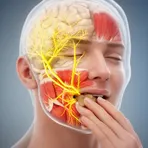
A nerve in the face that carries feeling and controls chewing muscles

A nerve in the head that carries feeling from the face and controls biting and chewing

The main nerve in the face that feels touch and controls chewing
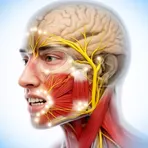
A large nerve in the face that sends touch signals and controls chewing muscles
Surface Forms
Morphology
The phrase is compositionally built from 'fifth' (ordinal), 'cranial' (relating to the skull), and 'nerve' (a bundle of nerve fibres), so a learner who knows the parts can infer it denotes the nerve number five among the cranial nerves. However, the precise identity and specialised functions (i.e. the trigeminal nerve and its sensory/motor roles) require medical knowledge beyond simple word combination. Because the overall referent is predictable in general but relies on domain-specific conventions, it is best classified as partially transparent.
Etymology
Fifth cranial nerve The name comes from how doctors number the nerves that come from the brain: it is the fifth of the cranial nerves. It is also called the 'trigeminal' nerve because it has three main branches like a three-pronged fork that give feeling to the face and help move the jaw to chew, so the name fits its job.

