

trigeminal nerve
- noun
- /traɪˈdʒɛmɪnəl nɜrv/
- Specialized
- Doctors often examine the trigeminal nerve to assess its role in facial sensations.
- branches of the trigeminal nerve
- root of the trigeminal nerve
- section of the trigeminal nerve
Examples
-
Notably, the patient's trigeminal nerve sensation was normal in all distributions, and there were no other cranial neuropathies.
Academic text (2004) -
Migraine is an inherited condition that is believed to be a neurological dysfunction involving the trigeminal nerve and the cranial vessels.
Academic text (2011) -
This is where those trigeminal nerve cells are.
-
Somatosensory, we'll be talking about the trigeminal nerve and from the the head region, especially the face.
-
But for some reason, when your trigeminal nerves get chilly, they tell your autonomic nervous system to tell your heart to slow things down.
-
Varicella-zoster may present with a prodrome of dental pain, preceding oral and skin vesicles and ulcers following one or more branches of the trigeminal nerve.
Academic text (2000) -
The trigeminal nerve becomes hyperactive and its branches trigger perivascular inflammation and vascular dilation.
Academic text (2011) -
Often, the cause is trigeminal neuralgia, a disorder characterized by paroxysmal brief attacks of severe pain within the distribution of one or more branches of the trigeminal nerve.
Academic text (1996) -
The trigeminal nerve is responsible for facial sensation and the motor control of chewing.
-
Injury to the trigeminal nerve can cause pain in the face and difficulty with biting.
Synonyms
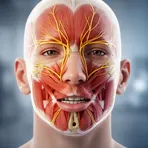
A main nerve in the face that carries feeling and controls chewing muscles

A nerve in the head that carries feeling from the face and controls biting and chewing

The main nerve in the face that feels touch and controls chewing
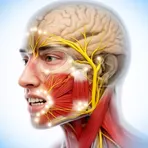
A large nerve in the face that sends touch signals and controls chewing muscles
Surface Forms
Morphology
This is a straightforward compositional noun phrase: 'trigeminal' specifies which nerve and 'nerve' names the anatomical structure, so together they directly denote the cranial nerve responsible for facial sensation. Although technical, the meaning follows standard anatomical naming conventions and is derivable from the constituents for a learner who knows both words.
Etymology
Trigeminal nerve comes from tri- meaning 'three' because the nerve splits into three main branches across the face. These branches carry feeling and help with chewing, so the name reminds us that this one nerve controls three big face areas and explains why damage causes numbness or pain.

