
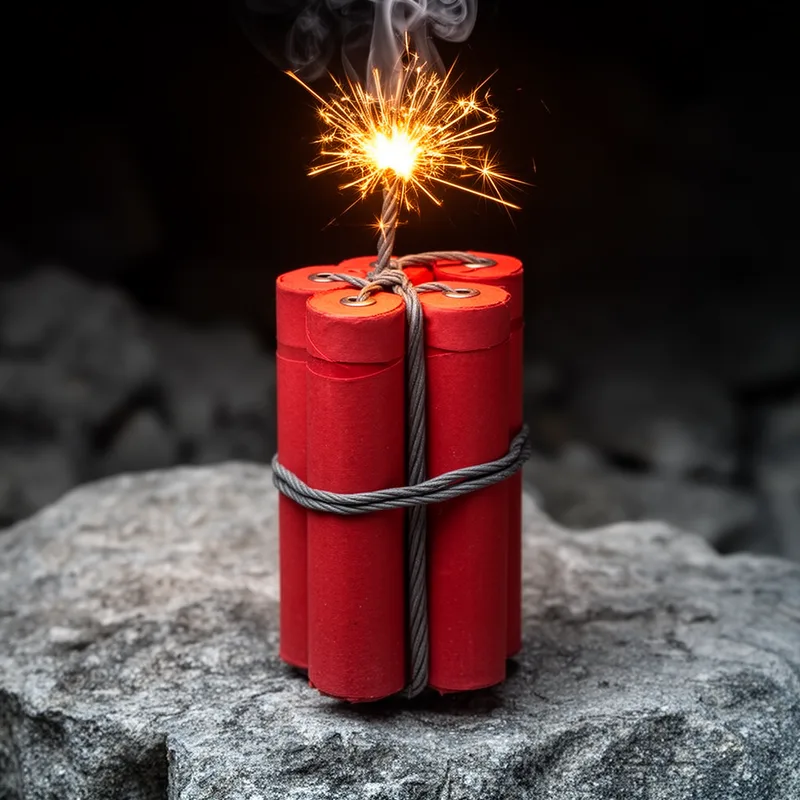
explosive
 336
5.5
336
5.5

- noun
- /ɪkˈsploʊsɪv/
- Specialized
- Ships were now being made out of steel and iron and using explosive shells rather than solid cannonballs.
- use of explosives
- high explosives
- underwater explosives
Loading YouTube…
Watch on YouTubeSo you have big slabs of PE and, and explosives, PE plastic explosives.
- So you have big slabs of PE and, and explosives, PE plastic explosives.
- The film crew, the camera was rigged with explosives.
- Ammonium nitrate is both a fertilizer and an explosive.
- But if you had an estimate, you know, how many explosives did you do you think you may have detonated?
- We had somebody who's specialty was studying how things blow up because a lot of explosives are used in coal mining.
- They need, they need kinetic weapons like, you know, gunpowder, explosives with, you know, artillery, old school.
- Joey, this is the transition of World War One explosives.
- You don't want to strip people of healthcare until after the holiday that mixes booze and explosives, OK?
- I'm like, I can switch the days between that explosives and we'll find a bitch in LA before that.
- Some people say that they were rigged with explosives so that they would collapse from explosives after the planes had hit them.
- You think about, for example, the use of sound effects or explosives or things like that, that are nothing like what they are.
Examples
-
During the examination, the students learned about various types of explosive compounds and their reactions.
-
According to this, you were arrested in 1925 for illegal possession of explosives.
-
There was not enough explosive at the farm to cause much of a blast.
Fiction book (1995) -
Yeah, little tiny bits of explosive material.
-
This first one is a cylindrical explosive with a hole in the top.
-
Oil and gas companies are more aware of the potential impacts of explosives on sea turtles.
Academic text (1994) -
This is also a very important thing where you're handling dusty explosive materials.
-
That means 1000 packs of high explosives and 1000 crack rifles.
-
"First, we've been able to track the explosives used to their point of origin: a manufacturer in Arizona.
Fiction book (1996) -
After the first blasting on Halmarin-IV, they banned all explosives from those planets.
Fiction book (1991)
Synonyms
 138
5.1
138
5.1
An explosive material used to break rock or destroy buildings
 51
3.2
51
3.2
A fine powder that burns quickly and makes explosions for guns and fireworks
 13
5.8
13
5.8
A very strong chemical that explodes quickly and makes a lot of gas and energy
 9
6.1
9
6.1
A soft, strong material used to make bombs or to break large things
 6
4.2
6
4.2
An amount of material placed to blow up at one time
 1
5.8
1
5.8
A chemical that can explode and cause a sudden violent reaction

 1
6.2
1
6.2
A mix of chemicals that can burst apart with great force when heated or hit
 1
7.6
1
7.6
An explosive that burns slowly and does not make a strong shock wave like black powder
A strong chemical charge in shells or bombs that makes a violent blast

A small bomb that makes a sudden blast to break things like a wall or lock

A strong chemical that pushes shells, rockets, or torpedoes forward

A substance that explodes to push a shell or rocket forward
Antonyms

Compounds

- Specialized
13
5.8
A very strong chemical that explodes quickly and makes a lot of gas and energy

- Specialized
1
7.3
A weapon that sprays fuel into the air and then sets it on fire to make a very strong blast
- Specialized
1
5.8
A chemical that can explode and cause a sudden violent reaction
- Specialized
1
6.2
A mix of chemicals that can burst apart with great force when heated or hit
- Specialized
1
7.6
An explosive that burns slowly and does not make a strong shock wave like black powder
- Specialized
A small bomb that makes a sudden blast to break things like a wall or lock

- Specialized
A machine that uses X-rays and computers to find plastic explosives in luggage, often at airports


- Specialized
A way to find tiny amounts of explosives on bags using a cloth and a machine
- Specialized
A strong chemical that pushes shells, rockets, or torpedoes forward
How Violent
- Specialized
13
5.8

- Specialized
- Specialized
336
5.5
- Specialized
1
7.6
180
1.9
Surface Forms
Etymology
Explosive comes from Latin parts ex- 'out' and plaudere 'to clap', the same root as applaud. A chemical explosive is something that 'bursts out' with great force, quickly making gas and heat, which is why it can blow things apart.