

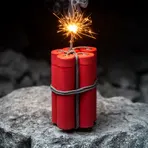
low explosive


 1
7.6
1
7.6
- noun
- /loʊ ɪkˈspləʊsɪv/
- Specialized
- For the fireworks display, they used a low explosive to create a safe, colorful burst in the sky.
Examples
-
The engineers tested the low explosive to ensure it would burn steadily without causing a loud detonation.
-
Mohamed said they were "model rockets," while the government admitted they were "low explosives."
Blog text (25) -
Many pyrotechnics rely on low explosives for special effects that produce bright flames without a violent blast.
Synonyms
 336
5.5
336
5.5
A chemical that reacts very fast, making gas and heat to blast things
Antonyms

- Specialized
13
5.8
A very strong chemical that explodes quickly and makes a lot of gas and energy
How Fast

Surface Forms
Morphology
A B1 learner who knows 'low' (not high) and 'explosive' (capable of exploding) can reasonably infer this refers to an explosive of lesser power or intensity, so the basic idea is derivable from the constituents. However, the exact technical sense — a slow-burning, subsonic deflagration rather than a detonation — is specialized and not fully predictable from the simple adjective+noun composition, making the phrase only partially transparent.
Etymology
Low explosive comes from a simple image: these materials burn and push out gas more slowly, so the effect is not the sudden, powerful shock of a big explosion. The word low means 'lower speed' and explosive shows they still give off energy, so low explosive means an explosive that burns more slowly rather than one that 'detonates'.