
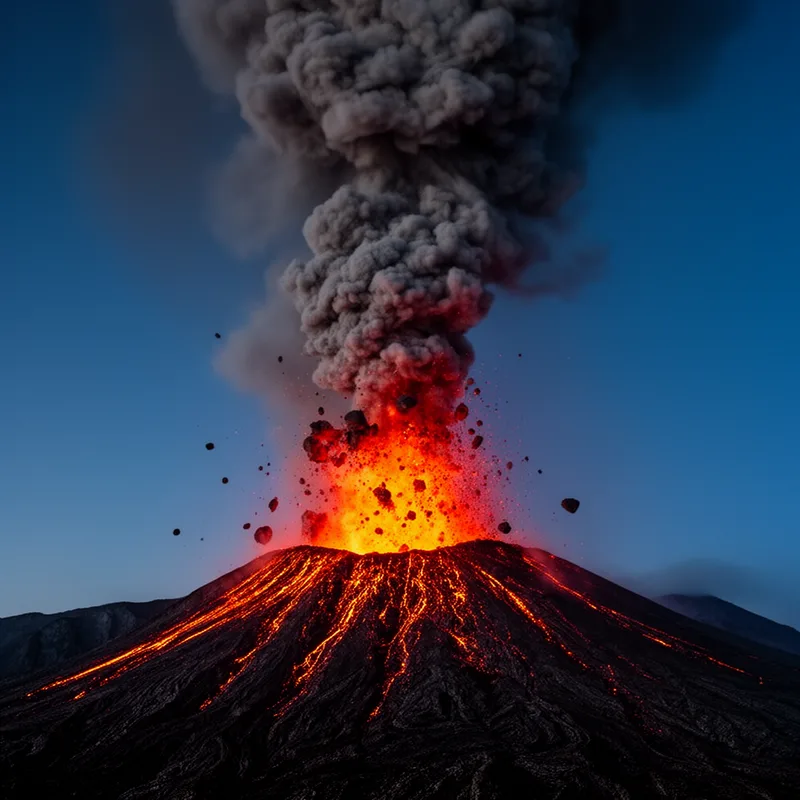
to erupt
 56
4.0
56
4.0

- verb
- /ɪˈrʌpt/
- Again, Mount Moa Moa has just erupted.
- a volcano erupted
Loading YouTube…
Watch on YouTubeFor some folks, it's like a volcano that erupts regularly.
- For some folks, it's like a volcano that erupts regularly.
- But we still await the first conclusive evidence of a volcano actually erupting on Venus.
- And I the, the remember the Icelandic volcano that erupted that like shut down kind of all Atlantic airspace.
- So Mount Vesuvius is, you know, is the volcano, the volcanic mountain that erupted and buried Pompeii.
- So I mean, the DHS will say, OK, what would a an earthquake or a volcano erupting cost?
- If sea levels can rise and undersea volcanoes erupt to create new land masses, does that mean Earth is gradually becoming a bigger sphere over time?
- It was living like living next to a volcano that could erupt at any moment and he could not help it.
- It was living like living legs to a volcano that could erupt at any moment and he could not help it.
Examples
-
Then, without warning, a billowing cloud of reddish-white smoke erupted from the base of the rocket.
Fiction book (1996) -
This famous geyser erupts several times a day.
-
So as we open it up right now, it's going to erupt all throughout the cone.
-
And that moon is so hot, there are volcanoes erupting from within.
-
So when volcanoes erupt, they put gases and particles into the atmosphere.
-
I was at Kilauea, the volcano which started erupting again last week.
-
Four years ago, a volcano erupted in Colombia.
-
The Changbai volcano on the border of China and Korea erupted in 946 A.D. with the force of over a thousand nuclear bombs.
-
Volcanic rocks form from molten lava which erupts at the Earth's surface and then cools.
-
The volcano began to erupt violently, sending ash and lava high into the sky.
Synonyms
 579
2.8
579
2.8
To burst suddenly and violently, making a loud noise and flying pieces
 534
2.7
534
2.7
To cause something to explode violently
 7
6.4
7
6.4
To push out large amounts of smoke or ash suddenly
 5
5.4
5
5.4
Suddenly start to happen with a lot of energy

To burst out suddenly and forcefully like a fountain
To send out something suddenly and strongly, like smoke or words
Phrasal Verbs



How Violent

Surface Forms
Morphology
erupt = e + rupt
Although historically analysable as e- (out) + rupt (break), 'rupt' is not a standalone English word, so an average B1 learner cannot reliably derive the meaning from the parts.
Etymology
The word erupt comes from Latin parts e- 'out' and rupt 'break', the same root you see in interrupt. So when a volcano erupts it 'breaks out' — suddenly throwing lava, ash, or steam out with great force.