
to erupt
 13
4.2
13
4.2

- verb
- /ɪˈrʌpt/
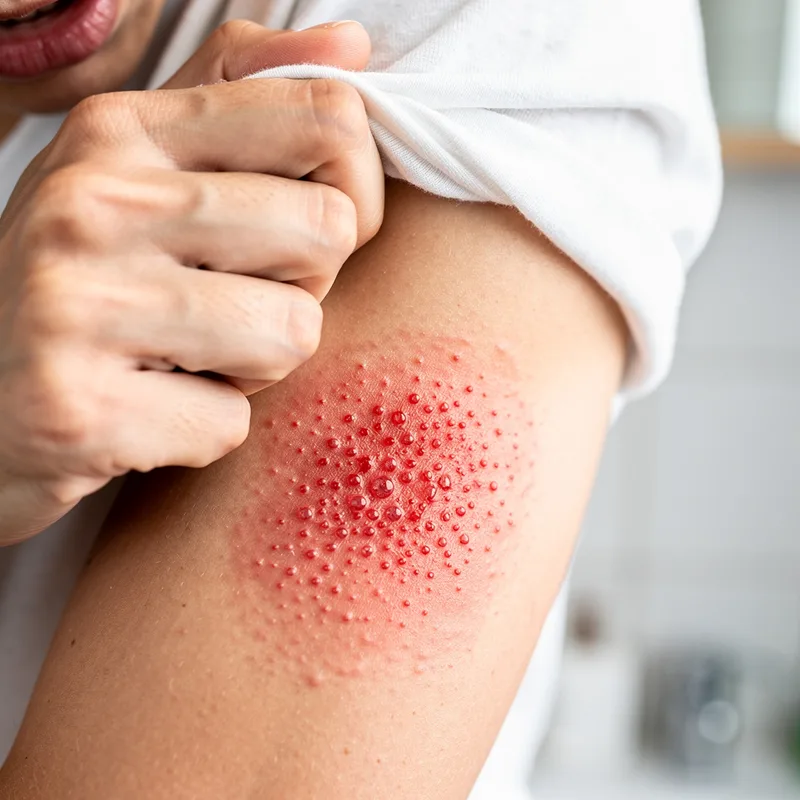
- After a few hours in the sun, a rash began to erupt on her arms.
Examples
-
In two or three days pink lesions appear all over his body, along with small pustules... ...that soon erupt with blood and pus.
-
The contents of the first angel's bowl caused repugnant and repulsive wounds to erupt on people's skin.
Academic text (2015) -
Then angry blisters erupted on his forehead, and he too fell forward, dead.
Fiction book (1996) -
Kieran flapped hard, his breaths erupting from his lungs as he strained to catch up to Leanna.
Fiction book (1998) -
The allergic reaction caused hives to erupt across his chest and back.
-
Within minutes, the mosquito bites started to erupt into itchy red welts.
Synonyms
 24
4.0
24
4.0
To develop spots or a rash on the skin
 23
4.7
23
4.7
To become suddenly stronger or worse, often for a short time
 5
5.4
5
5.4
Suddenly start to happen with a lot of energy
 2
3.4
2
3.4
Start suddenly and appear or happen quickly
Antonyms

Phrasal Verbs



How Severe

Surface Forms
Morphology
erupt = e + rupt
Although historically analysable as e- (out) + rupt (break), 'rupt' is not a standalone English word, so an average B1 learner cannot reliably derive the meaning from the parts.
Etymology
The word erupt comes from Latin parts e- 'out' and rupt 'break', the same root you see in interrupt. So when a rash or spots erupt on the skin they 'break out' suddenly, which is why we use erupt for things that appear quickly on the body.