
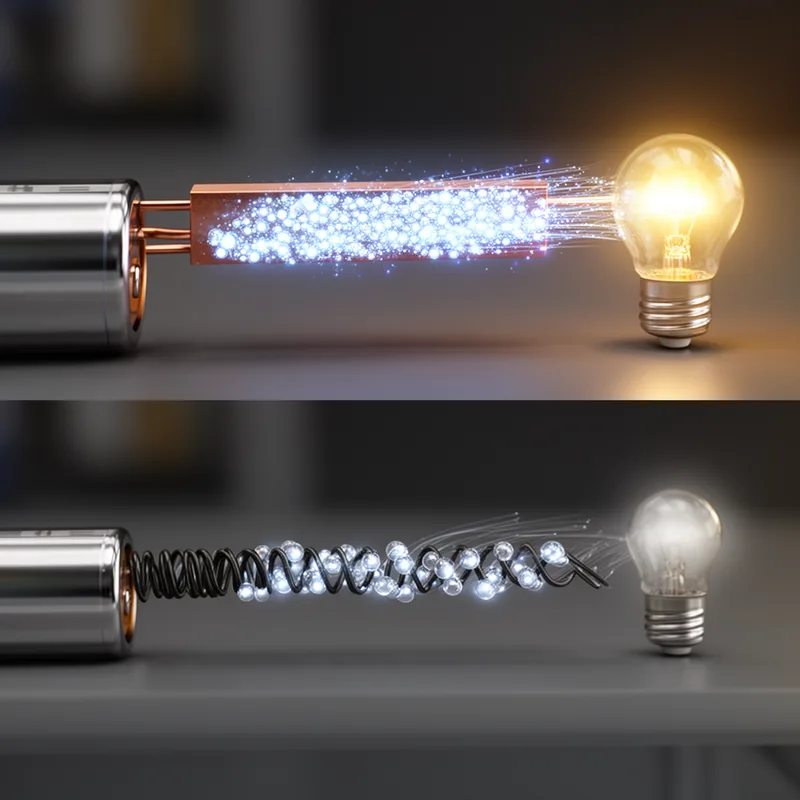
electrical resistance


 1
3.9
1
3.9
- noun
- /ɪˈlɛktrɪkəl rɪˈzɪstəns/
- Specialized
- In essence, a bolometer is a piece of material whose electrical resistance varies with its temperature.
- changes in electrical resistance
Examples
-
Thermistors are sensors that change their electrical resistance with changes in temperature.
Academic text (1996) -
Microcracks and other forms of mechanical degradation influence characteristics such as electrical resistance, which can further impact mechanical behaviors (including creep) during product operation.
Academic text (1998) -
A percentage of the power delivered is lost as a function of electrical resistance in the distribution cable.
Academic text (2002) -
All RTDs operate on the principle that changes in temperature cause changes in electrical resistance.
Academic text (1994) -
The material's electrical resistance makes it suitable for use in double-insulated appliances as well.
Academic text (1999) -
Strain gauges respond to the deformation of the metal to which they are bonded by a change in their electrical resistance.
Academic text (1993) -
A change in temperature causes a change in the sensing element's electrical resistance, which is transmitted to a voltmeter for measuring and then to a computer for converting into thermal values.
Academic text (1994) -
Each of these systems utilizes a grid-based sensor in which the rows and columns are separated by a polymer whose electrical resistance varies with force.
Academic text (1996) -
An electrolyte with a low conductivity or high electrical resistance produces a slow corrosion reaction, while an electrolyte with a high conductivity and low resistance corrodes rapidly.
Academic text (1996) -
Thermistors change their electrical resistance as the temperature varies, making them useful for temperature sensing.
Synonyms
 46
4.4
46
4.4
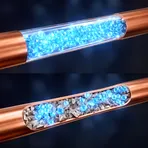
How much a material reduces electric current
 2
7.9
2
7.9
The amount a material stops electric current, measured in ohms
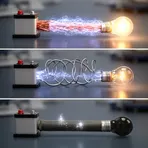
How much a material stops electric current from flowing
A measure of how much a wire or part stops electric current, shown in ohms
Antonyms
How Resistant
- Specialized
5
4.7

- Specialized
1
3.9
- Specialized
7
4.1
- Specialized
14
3.9
- Specialized
10
6.4
Surface Forms
Morphology
This noun phrase is a direct composition: 'electrical' specifies the domain (electricity) and 'resistance' denotes opposition to flow, so the combined meaning 'opposition to electric current' is literally derivable from its parts. Although somewhat technical, the construction is transparent and follows standard adjective + noun composition found across languages, so a B1 learner who knows both words should understand it.
Etymology
Electrical resistance comes from a simple image: imagine electricity as water in a pipe, and a narrow or rough pipe 'resists' the water so less can pass. So, electrical resistance, literally electrical + resistance, means a material 'resists' or 'slows' the electric 'flow', which is why copper has low resistance and lets electricity pass easily.