
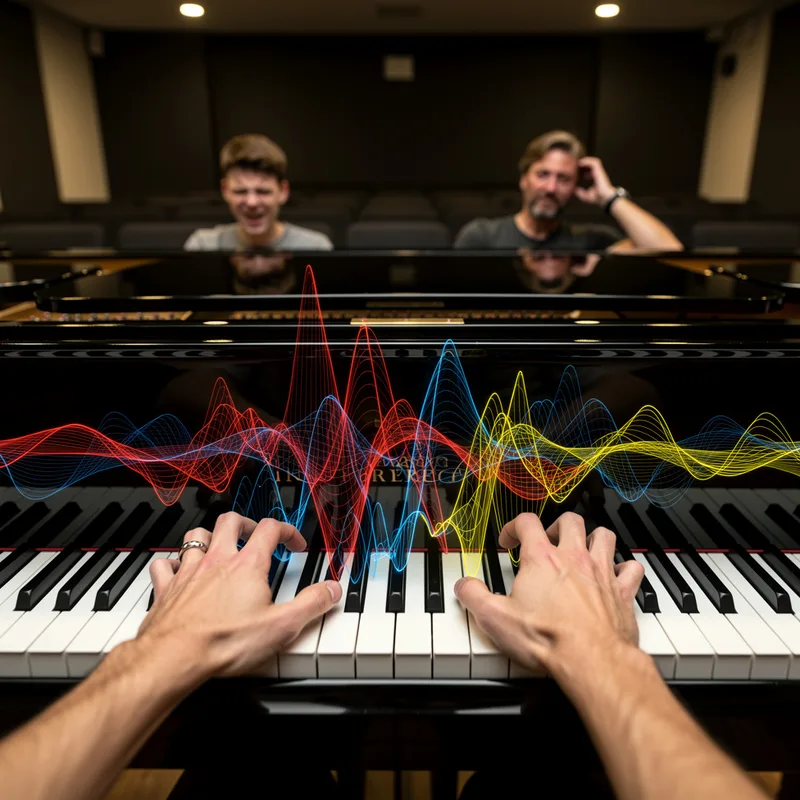
dissonant
 3
7.3
3
7.3

- adjective
- /ˈdɪsənənt/
- Specialized
- The prevailing theory of music in the brain is that dissonant combinations share frequencies that are a bit too close.
- dissonant chord
- dissonant note
- dissonant sound
Loading YouTube…
Watch on YouTubeIt's not getting real dark with like dissonant notes in it.
- It's not getting real dark with like dissonant notes in it.
- The four one cadence has only one dissonant note and it resolves down South from F major to C major.
- Well, the same thing with these dissonant intervals and dissonant chords is that you have to figure out the right space for them to occupy intervalocally.
Examples
-
For example, Jamie is asked to improvise "moody music that gradually becomes brighter" and "music that becomes increasingly dissonant."
Academic text (1991) -
The Eno-produced set opened with the Contortions' dissonant, brutal, weirdly danceable James Brown pastiche "Dish It Out."
Blog text (29) -
It's often dissonant, hard on the ear.
Fiction book (1999) -
That sound, it's a dissonant sound resolving to consonant.
-
But actually the Scorpions are so melodic, even when they are being dissonant and stuff like that.
-
Instead, I started quietly up the top flight of stairs, letting the dissonant sounds swell and reach out to me, pulling me upward toward their source.
Fiction book (1990) -
Each minute, the moaning grew louder and more dissonant, while above us the clouds fractured like rotten ice melting on a spring day.
Fiction book (1999) -
What remained was an enthralling balance between silence and sound, shadowy melodies, and hints of dissonant or tonal harmonies.
Blog text (5) -
Arnold Schoenberg (1874-1951), an Austro-Hungarian composer known for his dissonant twelve-tone music, created a system of notation known as "A New Twelve-Tone Notation."
Academic text (1997) -
The orchestra created a dissonant sound that left the audience feeling uneasy.
Synonyms
 9
7.4
9
7.4
Not fitting together and often clashing in sound or opinion
 2
8.4
2
8.4
Making a loud, harsh noise that is unpleasant to hear
 1
5.3
1
5.3
A sound that does not have a pleasant tune when sung
 1
7.7
1
7.7
A chord that sounds tense and unfinished

 1
9.3
1
9.3
Has a loud, harsh sound that is unpleasant
 1
6.0
1
6.0
Having a harsh sound that is not pleasant to hear

Making a harsh, clashing sound

A sound that does not fit with other tones and seems rough

A note that does not fit the other notes and sounds different

A harsh, unpleasant sound that hurts the ears

Not pleasing together in sound, color or feeling

Not having a pleasant, musical sound

Not making a pleasant tune
Antonyms

Compounds

- Specialized
A group of musical notes played together that sound tense and not smooth
How Dissonant

Surface Forms
Morphology
dissonant = dissonance (transparent) = dissonance + ant
The adjective denotes 'characterized by dissonance', a direct adjectival derivation from the noun.
Etymology
The word dissonant comes from Latin parts dis- 'not' and sonare 'to sound', so it literally means 'not sounding together'. You can see the same root in resonate, and that's why dissonant in music describes notes that clash or sound harsh, creating tension.