
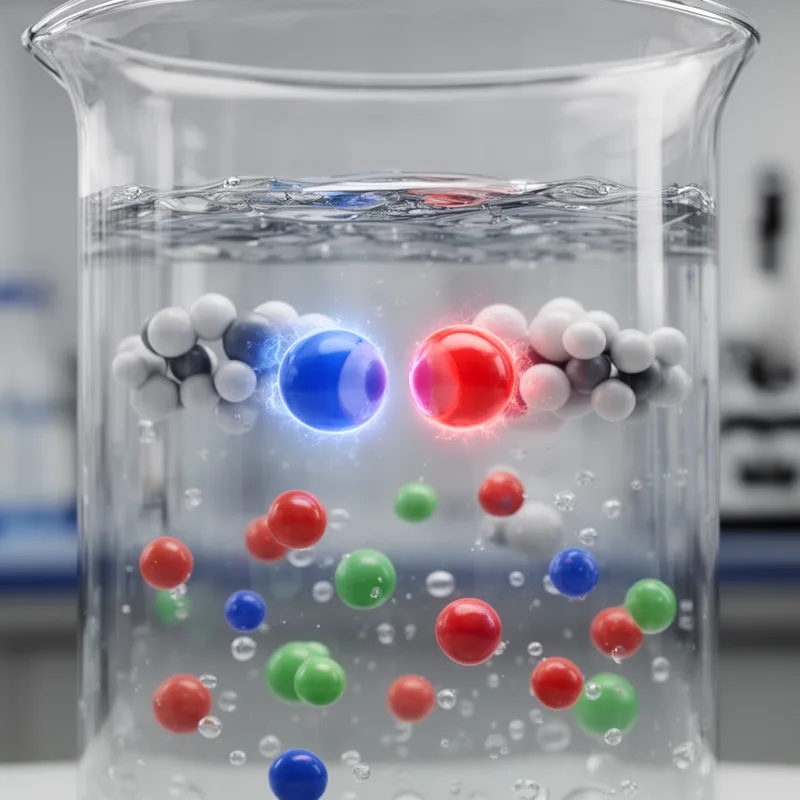
dissociation


 1
7.0
1
7.0
- noun
- /ˌdɪsəˈsoʊʃən/
- Specialized
- The researchers focused on the dissociation of the complex molecules to understand the reaction rates.
- bond dissociation
- dissociation energies
- dissociation of an acid
Loading YouTube…
Watch on YouTubeAnd we're, we started last time looking at the example of the dissociation of water into ions to give H plus and OH minus both of course solvated.
- And we're, we started last time looking at the example of the dissociation of water into ions to give H plus and OH minus both of course solvated.
Examples
-
It may reasonably be assumed that the partial dissociation is a stage in the complete process.
-
In 2005, the group of Michael Fayer used 2D IR spectroscopy to study the formation and dissociation of solute-solvent complexes.
Academic text (2012) -
And we could, we could mimic this in solution by adding adverse conditions and monitoring the dissociation of this complex.
-
The variation of cross-peak volume with delay time measures the creation and dissociation rates.
Academic text (2012) -
Thus, the oxygen vacancies would serve as the active sites for the surface oxygen species and boost the dissociation of CO2 to CO.
Academic text (2018) -
The experimenters observed a density collapse and interpreted it as arising from the dissociation of the molecules.
Academic text (1998) -
The scientists noted that the heat caused the dissociation of water into hydrogen and oxygen gas.
-
In the laboratory, they measured the dissociation of the salt into its constituent ions in solution.
Synonyms
 89
2.6
89
2.6
The process of moving apart or staying apart
 19
4.1
19
4.1
A process in which a substance is broken into simpler parts by chemicals or living things
 4
4.9
4
4.9
A split into parts along natural lines, for example in rocks or cells
 2
5.7
2
5.7
Breaking a substance into simpler parts
 1
7.9
1
7.9
Breaking a whole into smaller separate parts
Antonyms
Compounds

- Specialized
A number that shows how easily a substance breaks into charged parts in water

- Specialized
The energy needed to break all the bonds in a molecule into separate atoms

- Specialized
Acids break into hydrogen ions and bases into hydroxide ions in water, forming salt and water

- Specialized
Energy needed to break molecules into smaller parts in a hot gas or liquid

- Specialized
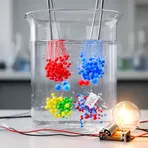
An explanation of how acids and bases split into charged particles in water
- Specialized
A chemistry idea that acids, bases, and salts split into charged particles in water
How Dissociated

Surface Forms
Morphology
dissociation = dissociate (semi-transparent) = dis + associate + ion
The noun is a regular process/result formation from the verb 'dissociate'.
Etymology
Dissociation comes from Latin parts dis- 'apart' and soci- 'companion', the same root as associate. In chemistry, dissociation is when a molecule 'parts from' its partner and splits into smaller, separate parts.