
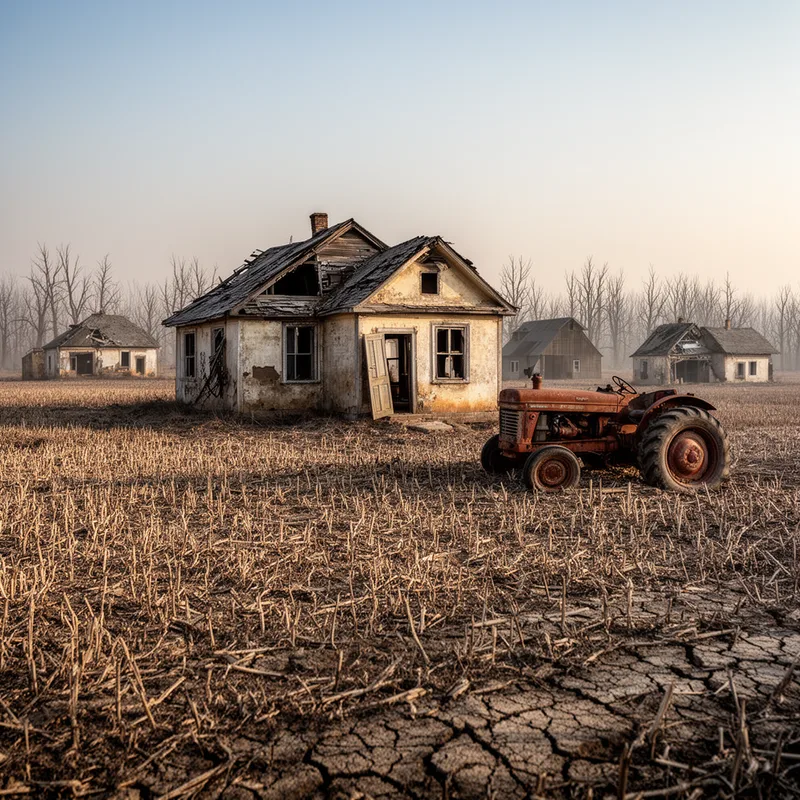
to desolate


 1
7.2
1
7.2
- verb
- /ˈdɛsəˌleɪt/
- As the factory closed, it desolated the community, driving families away in search of work.
Examples
-
The records of the cabildo of Guayaquil list numerous reports of disastrous fires that repeatedly desolated the city.
Academic text (1991) -
Also making the trek to desolate Punta de Lobos were two former BWWT champs, Jamie Sterling and Carlos Burle.
Blog text (11) -
But then we see that human progress has been carried out by desolating the natural world.
Academic text (1993) -
We want to then desolate and then energize these molecules and see how they unfold.
-
By 1638, much of the Hessian countryside was desolated.
Academic text (1993) -
To combat this aggressive invasion of their homeland, the Russians welcomed the French with a destroyed storehouse, a widely desolated land.
-
Finally, in the far distance, the plague's desolating effects are full-blown: the city has been abandoned by the able-bodied, and civilized communication is no longer possible.
Academic text (2004) -
In the absence of fresh targets of value blundering into their areas and still out of food, MUYs will begin to forage beyond their desolated home neighborhoods and into suburban borderlands.
Blog text (26) -
The once thriving town was desolated by the aftermath of the hurricane, leaving only rubble and silence.
-
War had desolated the region, transforming vibrant cities into ghost towns devoid of life.
Synonyms
 221
4.9
221
4.9
To destroy something greatly or make people feel deeply shocked and sad
 73
6.6
73
6.6
To damage a place or thing very badly
 38
4.7
38
4.7
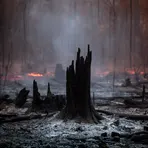
To destroy a place completely, leaving only ruins
 12
7.9
12
7.9
To destroy a place and leave it ruined
 3
7.4
3
7.4
To reduce the number of people living in a place until few or none remain
 1
9.1
1
9.1
To cause great suffering or damage
Antonyms


How Ruined

Surface Forms
Morphology
desolate = de + solate
The verb reflects the historical formation de- + solate meaning 'make solitary/empty', but 'solate' is not a standalone modern English base, so the relation is only partially inferable to learners.
Etymology
Desolate comes from the Latin parts de- ('completely' or 'away') and solus ('alone'), so it originally meant to 'make alone'. That's why to desolate a place is to leave it empty and lifeless.