
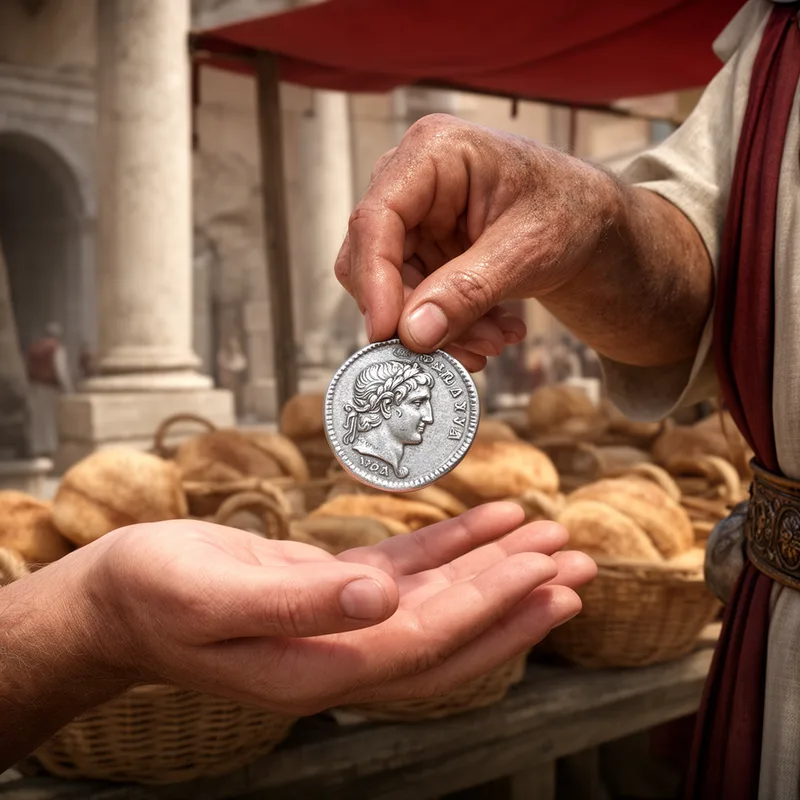
denarius
 1
9.9
1
9.9

- noun
- /dɪˈnɛəriəs/
- Archaic
- A quart of wheat for a denarius, and three quarts of barley for a denarius NKJV.
- silver denarius
Loading YouTube…
Watch on YouTubeAnd he says, if you each go out and work the fields, I'll give you a denarius, which was a Roman coin at the end of the day.
- And he says, if you each go out and work the fields, I'll give you a denarius, which was a Roman coin at the end of the day.
Examples
-
It's funny all the emphasis on monetary tithing, but didn't Jesus deny the worthiness of money after he pointed out Caesar's face on the denarius?
Blog text (6) -
One final Roman coin worth mentioning is a silver denarius struck by the degenerate emperor Elagabalus (see figure 8).
Academic text (1995) -
"They brought him a denarius, and he asked them, "Whose image is this?"
Blog text (34) -
Four shekels for one denarius.
-
And he says, if you each go out and work the fields, I'll give you a denarius, which was a Roman coin at the end of the day.
-
An early example is a silver denarius, a Roman silver coin that weighs about 4.0 grams.
Academic text (1995) -
The crescent Moon also appears on a silver denarius struck by the Roman moneyer Lucius Lucretius Trio around 74 B.C. (see figure 7).
Academic text (1995) -
The silver denarius was a common currency used in ancient Rome for everyday transactions.
-
She paid for the bread with a single denarius, which had significant value in ancient Rome.
-
A typical Roman soldier earned a denarius each day for his service during the Imperial period.
Synonyms


 1
9.9
1
9.9
A silver coin from ancient Greece worth four drachmas
 1
9.9
1
9.9
A small gold coin used as money in ancient Rome
 1
9.9
1
9.9
A gold coin used in the Byzantine Empire and in medieval Europe

A coin used in ancient Rome to buy things
An old coin from Roman or Byzantine times

An old Greek coin used to buy things

A small ancient Greek silver coin used for everyday purchases
An old European coin used in the Middle Ages
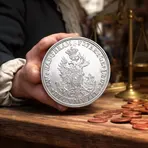
A large silver coin used in Europe between the 1500s and 1800s
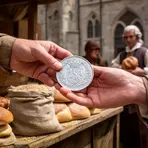
A large silver coin used in Europe long ago
Surface Forms
Etymology
Denarius was the name of a Roman silver coin, and the word comes from Latin deni, meaning 'ten', because it was originally worth ten small bronze coins, so a denarius was a common coin for everyday buying in ancient Rome.