
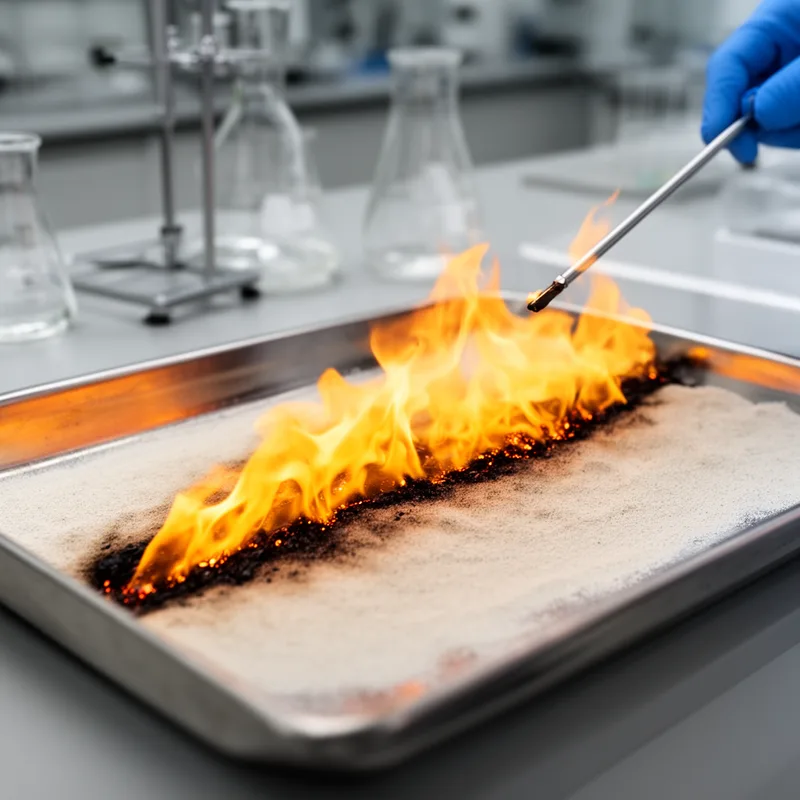
to deflagrate


 1
9.9
- verb
- /ˈdɛfləˌɡreɪt/
- Specialized
- The technician used a controlled spark to deflagrate the substance safely.
Examples
-
When the magnesium ribbon is ignited, it will deflagrate quickly, producing a bright flame and intense heat.
-
Because the powder can deflagrate violently, only experienced personnel are allowed to handle it.
-
Careful measures must be taken when chemicals are deflagrated in the laboratory.
-
The chemical will deflagrate when exposed to heat.
-
When ignited, the mixture deflagrates rapidly.
-
The fireworks will deflagrate in the air, creating a stunning display without any explosions.
-
Under the right conditions, certain chemicals will deflagrate rapidly, generating flames but avoiding an explosion.
Synonyms
 ∞
1.0
To be on fire or damage something with heat
 27
3.4
To burn or shine with very bright light
 13
7.4
To catch fire or make something burn
 12
4.6
To light up suddenly with a strong flame or bright light
 1
9.9
To start to burn suddenly and brightly
Antonyms

How Fast

Surface Forms
Morphology
deflagrate = flagrate (semi-transparent) = de + flagrate
'de-' + 'flagrate' is analyzable, but the base 'flagrate' is rare and 'de-' here is not a straightforward negative, so learners may be misled.
Etymology
The word deflagrate comes from the Latin parts de- and flagrare, meaning 'to burn'. It is related to the English word flame, so deflagrate means to burn very quickly with a strong flame rather than to explode.