
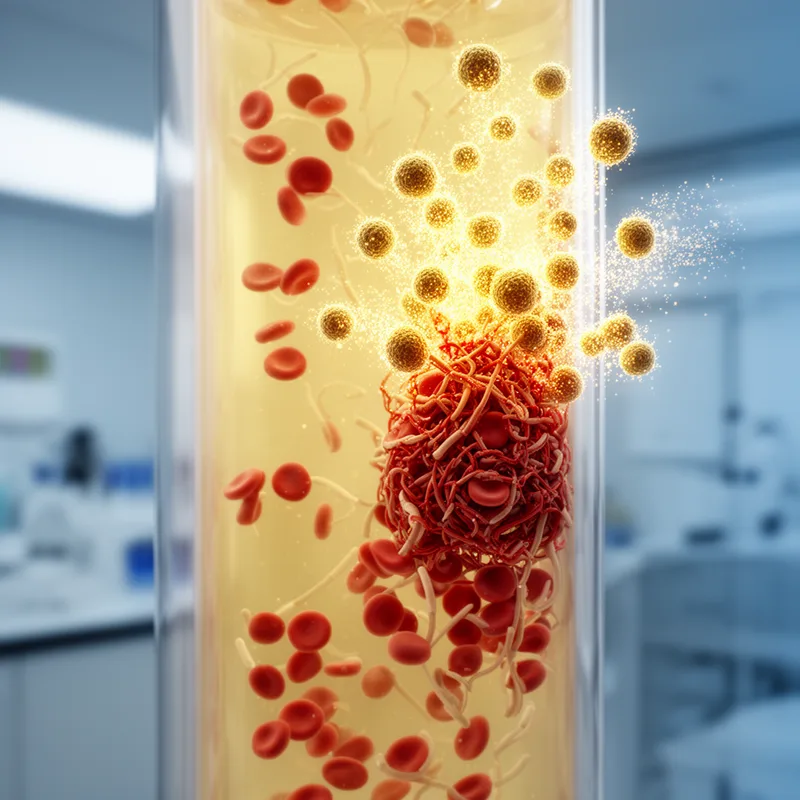
coagulase
- noun
- /koʊˈæɡjʊleɪs/
- Specialized
- In the laboratory, we tested various samples for the presence of coagulase.
- coagulase-negative staphylococci
- coagulase-negative
- coagulase-positive
Examples
-
Occurrence of S. aureus and its coagulase types in bioaerosols.
Academic text (2006) -
One patient's cultures (2%) were positive for Pseudomonas aeruginosa, and six (12%) were positive for coagulase-negative staphylococci.
Academic text (1998) -
Coagulase-negative staphylococci were the most frequently isolated organisms in our study, as in many other studies.
Academic text (2004) -
In findings similar to those of the present study, coagulase-negative staphylococci were the predominant bacteria.
Academic text (2004) -
Our study is consistent with Hoyt's results, which demonstrated a preponderance of coagulase-negative staphylococci.
Academic text (2004) -
The Bacti-Staph Latex 150 Test Kit was used to detect coagulase in staphylococci isolates.
Academic text (2009) -
Overall, S. aureus was seen in 43.5% of cases, P. aeruginosa in 28.8%, coagulase-negative staphylococci in 7.3%, and Enterobacter species in 3.4%.
Academic text (2005) -
Common pathogens are Bacillus, coagulase-negative Staphylococcus, Clostridium perfringens, Escherichia coli, and Aspergillus.
Academic text (1996) -
The doctor explained that coagulase is an enzyme that helps blood to clot.
-
Understanding how coagulase functions is crucial for studying blood coagulation.
Synonyms

 3
8.1
3
8.1

Something that makes a liquid like blood or milk become thick and form clots


 1
8.6
1
8.6
A substance or device that makes a liquid such as blood form clots
 1
8.0
1
8.0
A protein in blood that helps form clots
A group of proteins that helps blood form clots by changing prothrombin into thrombin

A substance from tiny blood cells that helps blood form a clot

A substance released by blood platelets that helps blood to clot
Surface Forms
Morphology
Etymology
The word coagulase breaks into coagul-, an old Latin root that means 'to clot' or 'curdle', and -ase, a common ending that means 'enzyme', as in lactase. So, coagulase is an enzyme that makes blood or plasma 'clot', which is why the word is used for enzymes that cause clotting in medical tests.